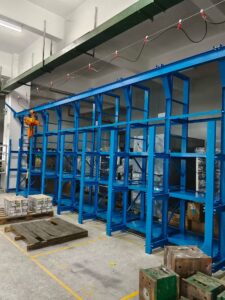
Struggling with damaged molds or worried about a potential rack collapse in your workshop? It’s a costly problem that puts both your equipment and your team at risk.
To calculate mold rack load capacity, you need to know the weight of your heaviest mold and the capacity of each shelf. Ensure the shelf's capacity exceeds the mold's weight. For total rack capacity, multiply the shelf capacity by the number of shelves, but never overload the entire structure.

Getting this calculation right is one of the most important safety checks you can perform in your facility. I've seen firsthand what happens when it's overlooked, and the consequences are never good. It's not just about protecting your molds; it's about ensuring a safe working environment for everyone. Let's walk through how to do this correctly so you can have complete peace of mind.
What Is Mold Rack Load Capacity?
Are you unsure what "load capacity" really means for your mold racks? This confusion can lead to accidentally overloading them, creating a serious hazard in your workspace.
Mold rack load capacity is the maximum weight a single shelf or the entire rack system can safely support without bending, breaking, or collapsing. This limit is determined by the manufacturer and is crucial for preventing accidents and protecting your valuable molds from damage.

When we talk about load capacity, we're really discussing two different numbers. First, there's the capacity of each individual drawer or shelf. This tells you the maximum weight you can place on a single level. Second, there's the total capacity for the entire rack unit. It's important to remember that you can't just load every shelf to its maximum if that total weight exceeds the overall limit for the rack. Think of it like a multi-story building; each floor has a weight limit, but the foundation has a total limit for the whole structure. As a manufacturer of these systems for over a decade, I always stress to my clients that they must respect both limits. Exceeding either one compromises the structural integrity and puts everything at risk. It’s a simple rule, but it’s the most important one for safe mold storage.
Why Correct Load Capacity Matters for Mold Safety?
Have you ever thought about what could go wrong if a mold rack is overloaded? The potential for catastrophic failure is high, leading to damaged molds, production downtime, and serious injuries.
Correct load capacity prevents rack collapse, protecting expensive molds from damage and ensuring worker safety. It maintains structural integrity, avoids costly operational disruptions, and is a fundamental part of a safe and efficient workshop environment. Overlooking it is a major risk.
![a safety officer inspecting a mold rack in a factory setting]
The importance of getting this right cannot be overstated. I once visited a facility where a rack had failed. A multi-ton mold had crashed to the floor, damaging not only itself but also the concrete beneath it and narrowly missing a worker. The cost of repairing the mold and the floor was huge, but the potential human cost was terrifying. This is why we build our racks with high-strength steel and rigorous quality checks. Correctly calculating and respecting the load capacity is the first line of defense against such disasters. It's not just a recommendation; it's a critical safety protocol. When you ensure your molds are stored within the specified limits, you are actively preventing accidents, protecting your investments, and creating a secure workplace for your team. It’s the foundation of responsible warehouse management.
What Key Factors Affect Mold Rack Load Capacity?
Do you know what makes one rack stronger than another? Simply buying a rack without understanding the factors that determine its strength can lead you to choose a system that isn't right for your heavy molds.
The key factors are the quality and thickness of the steel, the design of the beams and uprights, the welding quality, and the even distribution of the load. High-grade materials and robust engineering are essential for ensuring a rack can handle its stated capacity safely.

Let’s break down what really gives a mold rack its strength. It all starts with the raw materials.
| Factor | Description | Why It Matters |
|---|---|---|
| Steel Quality & Thickness | The grade and gauge of the steel used for the frame, beams, and shelves. | Higher quality, thicker steel provides greater resistance to bending and stress. We insist on premium raw materials for this reason. |
| Structural Design | The engineering behind the uprights, cross-bracing, and beam connections. | A well-designed structure distributes weight evenly to the strongest points, preventing localized stress and potential failure points. |
| Welding and Fasteners | The quality of welds and the strength of bolts used in assembly. | Weak welds or low-grade bolts are common points of failure. Strong connections are crucial for holding the entire structure together under load. |
| Shelf/Drawer Mechanism | The design of the sliding drawers, including the bearings and supports. | For drawer-style mold racks, the mechanism must be able to support the full weight of the mold, even when fully extended. |
As a manufacturer with ISO 9001:2008 certification, we scrutinize every one of these details. The thickness of the steel isn't just a number; it's a direct measure of the rack's backbone. The design isn't just about looks; it's about physics and distributing immense forces safely. This is why a cheaper rack often cuts corners on these hidden but vital factors, putting your assets and people at risk.
How Do I Calculate Mold Rack Load Capacity Step-by-Step?
Feeling uncertain about how to actually calculate the load for your racks? Guessing or using rough estimates is a recipe for disaster, but the actual calculation is straightforward if you know the steps.
First, determine the weight of your mold. Then, check the manufacturer's specified load capacity for a single shelf. Ensure the mold's weight is less than the shelf's capacity. Finally, respect the total rack capacity limit. This simple process prevents overloading.
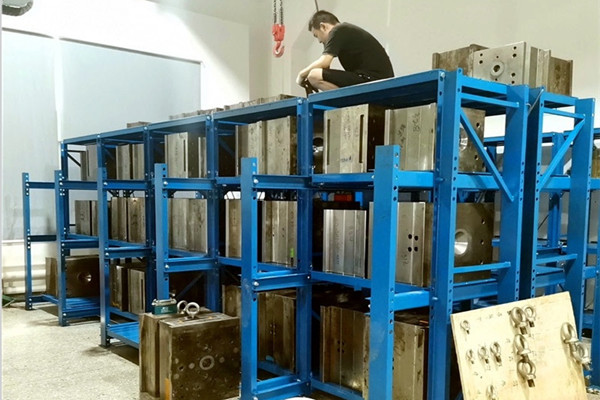
Let's walk through this process together. It's simpler than you might think.
Step 1: Determine the Weight of Your Mold
The most critical piece of information is the weight of the mold you need to store. If you don't know it, you're just guessing.
- Ask the Manufacturer: The easiest and most accurate method is to get the actual weight from the mold's manufacturer. They will have this on file.
- Calculate an Estimate: If you can't get the exact number, you can estimate it. Molds are mostly steel. You can calculate the mold's volume (Length x Width x Height) and multiply it by the density of steel (about 0.284 lbs/in³ or 7.85 g/cm³). Since molds have hollow parts, I suggest using about 70% of this calculated weight as a practical, safe estimate. For example, a solid block of steel measuring 20"x20"x20" would weigh over 2,200 lbs, so a mold of that size might be around 1,540 lbs.
Step 2: Check the Rack's Load Capacity
Every reputable mold rack will have its capacity clearly stated.
- Shelf Capacity: Look for a label or documentation specifying the maximum weight per drawer or shelf. This is the most important number for individual mold storage.
- Total Rack Capacity: Find the total maximum weight the entire unit can hold.
Step 3: Compare and Confirm
This is the final safety check.
- Rule 1: The weight of your mold must be less than the shelf capacity.
- Rule 2: The sum of all mold weights on the rack must be less than the total rack capacity.
Never load a 1,200 kg mold onto a shelf rated for 1,000 kg. It seems obvious, but this mistake happens. By following these simple steps, you ensure that you are using the equipment as it was designed, guaranteeing safety and protecting your valuable molds.
Conclusion
In short, calculating mold rack capacity is a vital safety step. Always know your mold's weight, respect the shelf and total rack limits, and you will prevent costly damage and ensure a safe workshop.