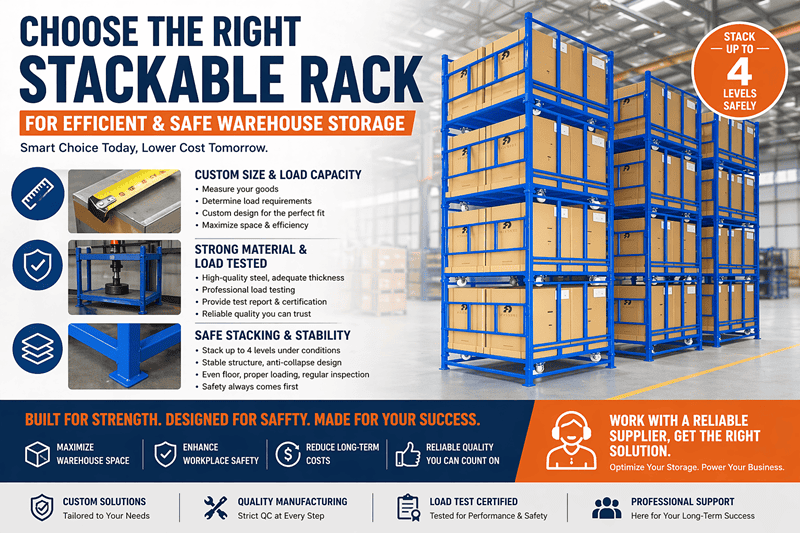
Struggling with messy, unsafe warehouse storage? Poorly chosen stackable racks1 waste space and create hazards, costing you time and money. The right choice is key to an efficient and safe operation.
To choose the right stackable rack, you must look beyond price. Focus on your specific needs, including custom dimensions2, verified load capacity3, material strength, and safe stacking heights4. A reliable supplier will help you optimize space, ensure safety, and reduce long-term costs.
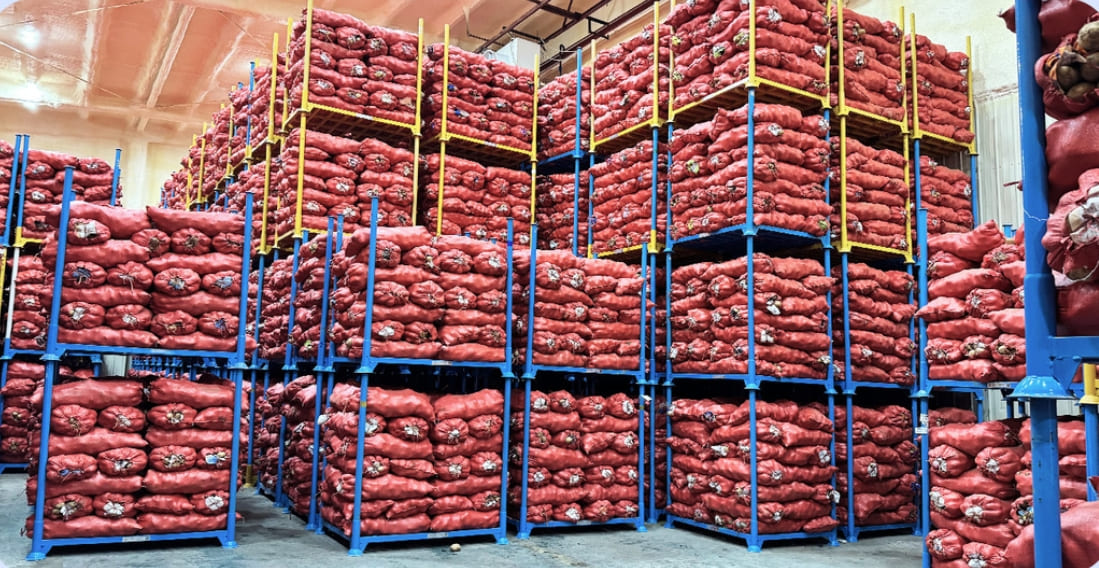
I've been in this industry for over a decade, and I've seen too many purchasing managers make the same mistake. They focus only on the initial price tag and end up with racks that don't fit their products, can't handle the weight, and create more problems than they solve. The truth is, the right stackable rack is an investment in efficiency and safety. Let's break down exactly what you need to look for to make a smart choice that pays off for years to come.
How to Choose the Right Size and Load Capacity for Stackable Racks?
Buying standard-sized racks that don't fit your products or handle their weight? This leads to wasted vertical space, overloaded racks that bend, and a constant struggle to organize inventory.
First, measure your largest and heaviest items to determine the required internal dimensions and load capacity. Always add a safety margin5 to the weight. Then, work with a supplier who can customize the rack to your exact specifications for an optimal, safe fit.
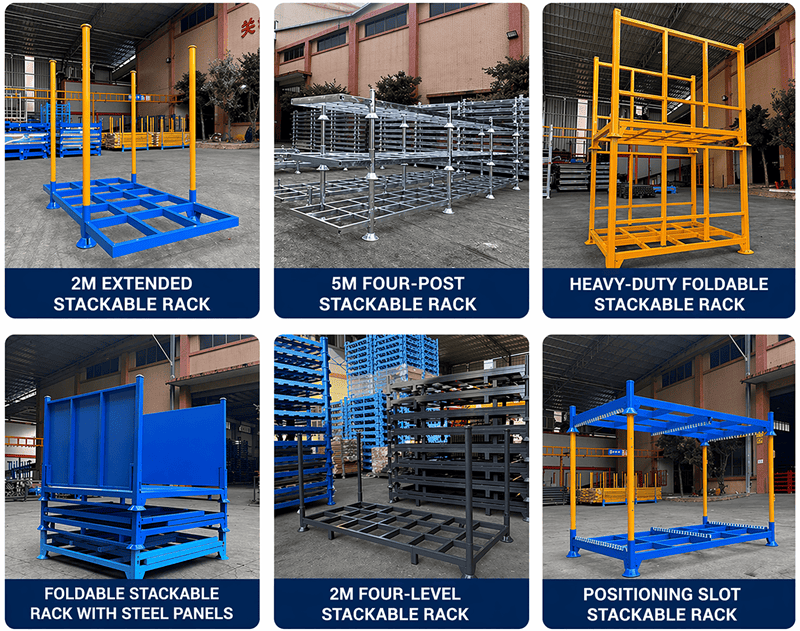
Getting the size and capacity right is the foundation of an effective storage system. If you get this wrong, nothing else matters. I've seen warehouses where racks were too small, forcing items to hang over the edge, or too large, wasting precious floor space. Customization isn't a luxury; it's a necessity for true efficiency.
Step 1: Accurately Measure Your Goods
Before you even talk to a supplier, you need to know your requirements. Get a tape measure and a scale. Measure the length, width, and height of the largest items or pallets you plan to store. Then, weigh the heaviest load. This data is your starting point. Don't guess. Precision here prevents major headaches later.
Step 2: Calculate the Required Load Capacity
Once you have the weight of your heaviest load, don't just use that number. You need to account for dynamic forces, like a forklift placing a pallet. A good rule of thumb is to add a safety factor. I always recommend a capacity that is at least 25% higher than your heaviest load. This ensures the rack can handle the stress of daily use without failing.
Step 3: Why Customization Beats Standard Sizes
Standard, off-the-shelf racks are designed for a "one-size-fits-all" approach that rarely fits anyone perfectly. Customizing your racks means every inch of your warehouse is used effectively.
| Feature | Standard Racks | Custom Racks |
|---|---|---|
| Fit | Generic, often wastes space | Precise fit for your products |
| Efficiency | Lower space utilization | Maximized vertical and horizontal space |
| Safety | May be overloaded or unstable | Engineered for your specific load |
| Cost | Lower upfront, higher long-term | Higher upfront, better long-term ROI |
Working with us, we can design a rack based on your exact product dimensions and weight, ensuring you get a perfect fit every time.
What Material Thickness and Load Testing Should You Check Before Buying Stackable Racks?
Worried the racks you're buying are made from flimsy materials that won't last? Thin steel can easily bend or collapse under load, leading to product loss and serious injuries.
Always ask the manufacturer for the steel grade and material thickness specifications. More importantly, you must insist on seeing a certified load test report6 for the specific rack design you are buying. This is the only way to verify it can safely handle its stated capacity.
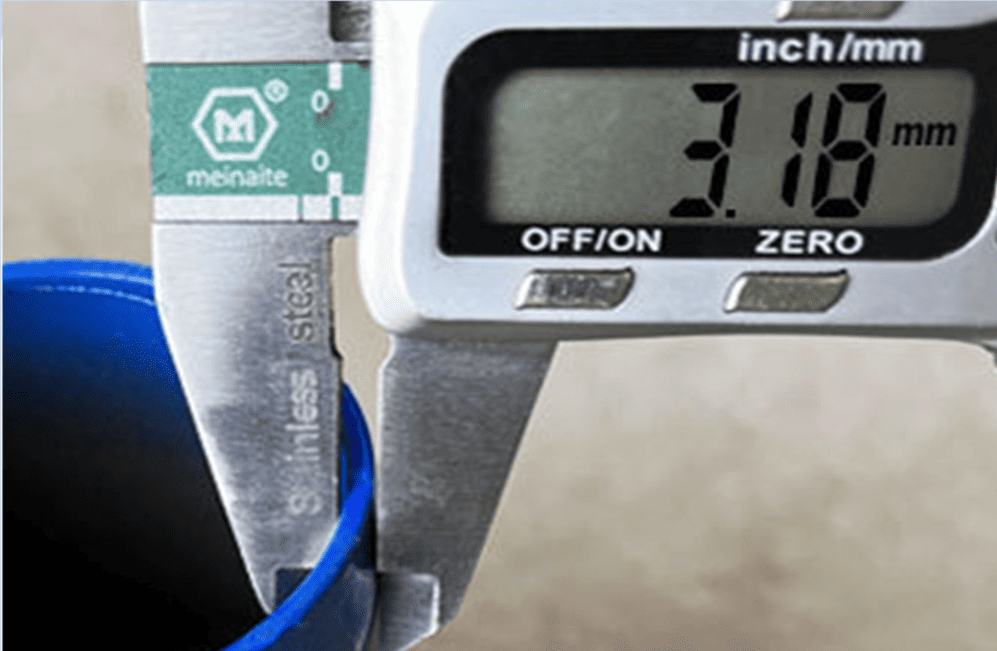
I can't stress this enough: a rack's stated capacity is meaningless without proof. Some suppliers cut corners by using thinner steel to lower their prices. This is incredibly dangerous. The structural integrity of the rack depends entirely on the quality of the material and the manufacturing process. You have to verify these details before you place an order.
Understanding Steel Thickness and Quality
The strength of a rack comes from the thickness and grade of the steel used. Steel thickness is often measured in gauge; a lower gauge number means thicker, stronger steel. For example, 12-gauge steel is much stronger than 16-gauge steel. You should also ask about the steel grade, as higher-grade steel offers greater tensile strength. Don't just accept a verbal promise. Ask for these specifications in writing on the quotation.
The Critical Role of Load Testing
A load test is a physical test where a prototype of the rack is loaded with weight until it fails or reaches a specific safety margin5. This process proves that the engineering calculations are correct and that the rack can perform as designed in the real world. A reputable manufacturer will have these tests performed by an independent third party and will be happy to provide you with the certificate. If a supplier can't or won't provide a load test report6, that's a major red flag.
Questions to Ask Your Supplier
To protect yourself, come prepared with the right questions. Here’s a simple checklist to use when vetting a potential supplier:
- What is the specific grade of steel used for the posts and beams?
- What is the material thickness (gauge) of the main structural components?
- Can you provide a certified load test report for this exact model?
- What welding techniques are used, and are your welders certified?
A trustworthy partner will have clear, confident answers and documentation to back them up.
What Is the Safe Stacking Height for Stackable Racks and How to Avoid Safety Risks?
Tempted to stack racks as high as possible to maximize space, but unsure if it's safe? Stacking too high creates an unstable column that can easily topple over, causing massive damage.
Most standard stackable racks1 are designed to be safely stacked up to 4 levels high. However, this is just a general guideline. The true safe height depends on the load per rack, the stability of the floor, and the rack’s specific design. Always follow the manufacturer's official guidelines.
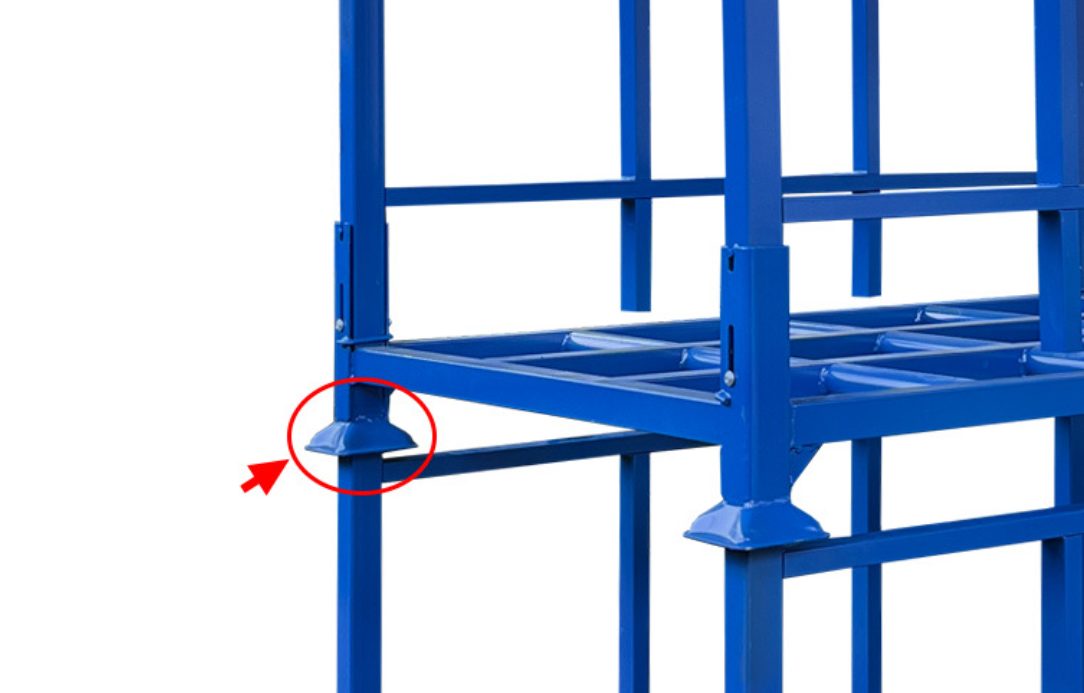
Maximizing vertical space is one of the main benefits of stackable racks1, but it has to be done safely. I've personally visited warehouses where a single forklift bump caused a domino-like collapse because the racks were stacked too high and were unstable. The consequences of ignoring safety limits are severe, both for your inventory and your employees.
The "4-High" Rule and Its Limitations
The common "4 levels high" rule is a good starting point, but it assumes ideal conditions: a perfectly level concrete floor, evenly distributed loads within the capacity limit, and no external forces. In reality, conditions are rarely perfect. The total weight of the entire stack is a critical factor. For example, four racks with a light load might be perfectly safe, while three racks with a very heavy load could be unstable. The manufacturer's specification sheet is your ultimate guide, as it will state the maximum number of units that can be stacked and the maximum total load for the stack.
Key Safety Risks to Avoid
Warehouse safety depends on identifying and mitigating risks. When it comes to stackable racks1, the biggest dangers often come from simple mistakes.
- Uneven Floors: Never stack racks on a sloped or damaged floor. The entire stack will be unstable from the base up.
- Improper Loading: Always place the heaviest loads on the bottom racks. A top-heavy stack is a recipe for disaster.
- Using Damaged Racks: Regularly inspect your racks for bent posts, cracked welds, or other damage. A damaged rack should be removed from service immediately.
- Forklift Operations: Most rack collapses are caused by impacts from forklifts. Ensure your operators are properly trained to handle stacked loads with care.
Implementing a Safety Protocol
You need to have a clear safety policy for your warehouse. This should include regular, documented inspections of all storage racks. Train your team to spot signs of damage or unsafe loading. Post clear signs indicating the maximum load capacity and stacking height7 for each type of rack. Safety isn't a one-time decision; it's an ongoing process of vigilance and training.
Conclusion
Choosing the right stackable rack comes down to focusing on custom sizing, verified material strength, and strict adherence to safety limits—not just the initial price. This ensures a truly efficient warehouse.
Explore how stackable racks can optimize your warehouse space and improve efficiency. ↩
Learn how to customize rack dimensions for a perfect fit in your warehouse. ↩
Understand the significance of load capacity verification for safety and efficiency. ↩
Find out the recommended stacking heights to ensure safety in your warehouse. ↩
Discover how to calculate safety margins to prevent rack failures. ↩
Learn why a load test report is crucial for ensuring rack safety. ↩
Understand the factors that influence safe stacking heights in warehouses. ↩