How Do You Choose the Right Small Parts Storage Cabinet for Your Factory?Disorganized small parts cost you money every day.1 Wasted search time and missing components silently kill your factory's efficiency. The right storage cabinet can fix this problem fast.
To choose the right small parts storage cabinet, you must match it to your factory’s specific needs. Focus on drawer size, load capacity, and material durability instead of just price. The best cabinet improves picking speed, reduces errors2, and fits seamlessly into your daily workflow.
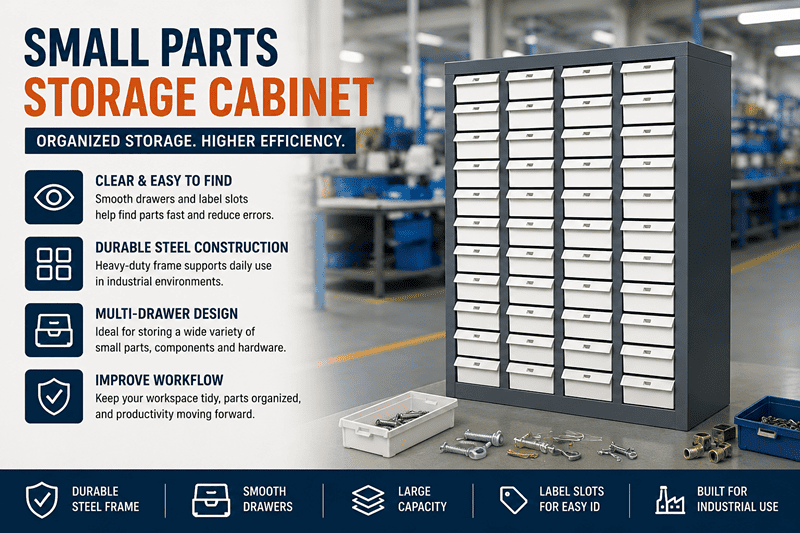
Most factory managers I talk to think they need more storage space. But what they really need is a smarter system. The wrong cabinet just creates more places to lose things. A good system turns your storage area into a productive part of your operation. It's about making your team's job easier and faster. Let's look at how to pick a cabinet that actually helps your bottom line.
How Do You Choose the Best Small Parts Storage Cabinet for Different Factory Environments?
Putting a flimsy plastic cabinet in a greasy workshop is a recipe for failure. The environment will destroy it, and you'll be buying a new one sooner than you think.
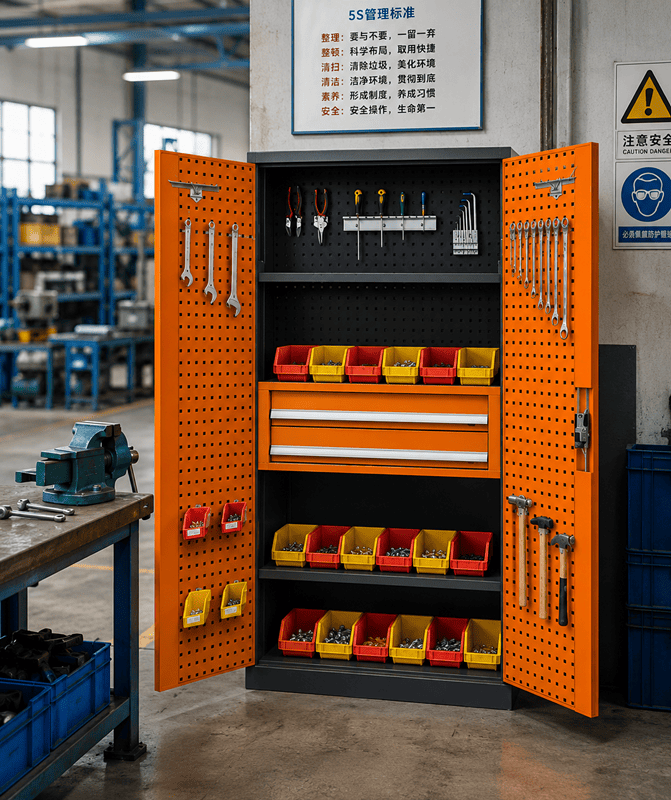
For harsh industrial environments with oil and dust, choose a steel parts cabinet.3 For clean, dry areas like labs or electronics assembly, a transparent plastic drawer cabinet is a practical choice. Always consider special needs like anti-static protection for sensitive components4.
Matching Cabinet Materials to Your Workshop
The environment where you place your cabinet is the most important factor. A cabinet is a tool, and you need the right tool for the job. In my years of experience, I've seen many factories make the mistake of choosing a cabinet based on price, only to have it fail because it wasn't built for their workshop's conditions.
For example, in machining workshops or auto repair shops, the air is often filled with oil mist and metal dust. Here, a heavy-duty steel cabinet is the only real option. Steel won't absorb oil, it's easy to wipe clean, and it can handle the occasional bump from a cart or tool. A plastic cabinet would become brittle and crack.
On the other hand, for an electronics assembly line or a medical device lab, the priorities are different. You need to prevent static discharge and keep everything perfectly clean. An anti-static (ESD) plastic cabinet is designed for this. It protects sensitive components from damage. In these clean environments, clear plastic drawers also offer great visibility, which helps workers find tiny components quickly5.
Here is a simple breakdown:
| Factory Environment | Recommended Cabinet Material | Key Reason |
|---|---|---|
| Machine Shop / Metal Fabrication | Steel | Resists oil, dust, and impact |
| Electronics Assembly / Lab | Anti-Static Plastic | Prevents static damage, high visibility |
| General Warehouse / Light Assembly | Standard Plastic or Steel | Balance of cost and durability |
| Food Industry / Cleanroom | Stainless Steel / Food-Grade Plastic | Meets hygiene standards, easy to sanitize |
What Features Should a Small Parts Storage Cabinet Have to Improve Efficiency and Reduce Picking Errors?
Workers wasting precious minutes searching for a single screw is a hidden cost. These small delays add up to huge productivity losses and frustrating mistakes across your production line.
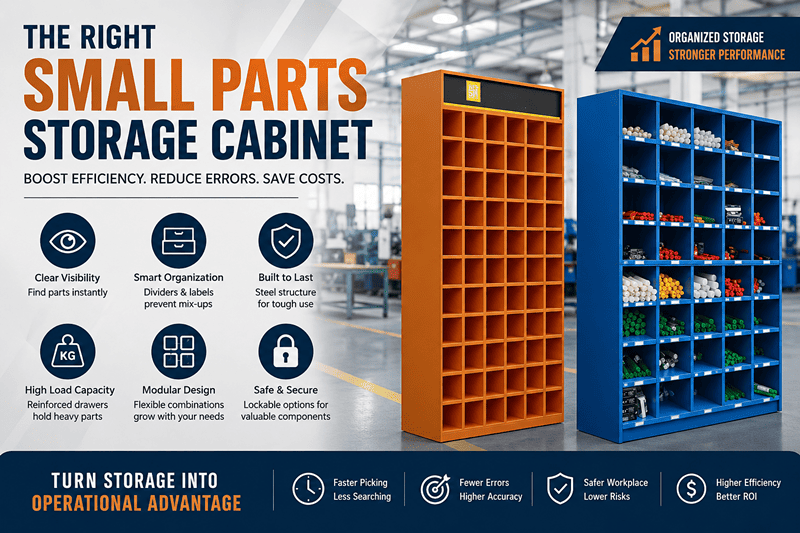
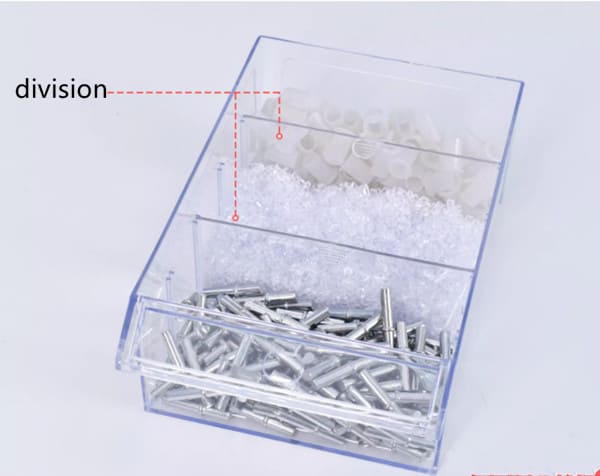
To improve efficiency, a cabinet must have features that support visual management. Look for clear or transparent drawers, easy-to-use label holders, and adjustable dividers. These simple features drastically reduce search time and help eliminate picking errors for good.
Key Features for Lean Manufacturing
A storage cabinet shouldn't just hold parts; it should actively help your workers perform better. This is a core idea in lean manufacturing and 5S management. The goal is to make the correct action the easiest action.6 Many buyers focus only on the cabinet's price, but the real expense is labor. Saving a few seconds on every single picking task creates massive productivity gains over a year.7
First, think about visibility. Can your workers see what's inside a drawer without opening it? Transparent drawers, like our tilt-out bins, are perfect for this. They allow for instant part identification. This single feature eliminates almost all the time spent guessing and searching.
Second is organization inside the drawer. Small components get mixed up easily. This is where adjustable dividers become essential8. They allow you to create custom-sized compartments for each specific SKU. This keeps everything neat and prevents costly mix-ups.
Finally, consider accessibility and labeling. Drawers should slide smoothly without jamming, even when full. A stuck drawer is frustrating and slows down the entire workflow. Every drawer must also have a clear, easy-to-read label holder. A good labeling system removes all guesswork and is critical for new employees or when people are working in a hurry.9
| Feature | How It Improves Efficiency |
|---|---|
| Transparent Drawers | Reduces search time by allowing instant visual identification of contents. |
| Adjustable Dividers | Prevents parts from mixing, improves storage density, and adapts to new inventory. |
| Smooth Drawer Slides | Ensures quick, frustration-free access to parts, speeding up the picking process. |
| Clear Label Holders | Eliminates guesswork and reduces picking errors, supporting a standardized system. |
Steel vs Plastic Small Parts Storage Cabinets: Which Is Better for Industrial Storage?
Choosing between steel and plastic can be confusing. If you pick the wrong one, you either waste money on a cabinet that breaks or overspend on one you don't need.
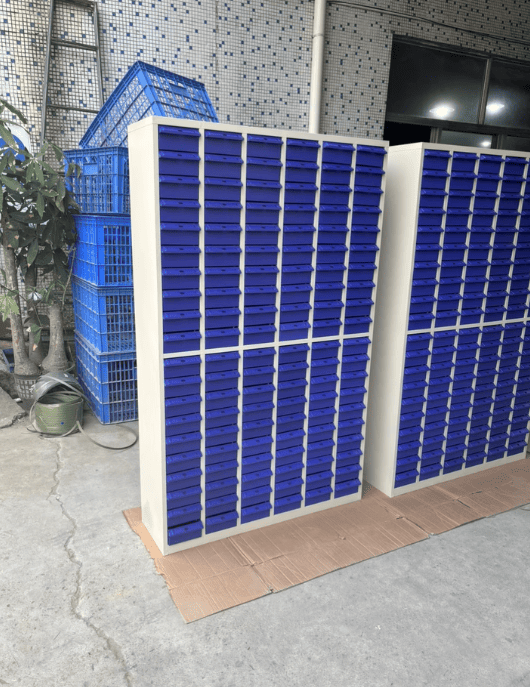
For heavy-duty industrial storage, a steel cabinet is almost always better. It offers superior durability, higher load capacity, and a longer service life.10 A plastic cabinet is a good, cost-effective option for lightweight parts in a clean, dry environment.
Comparing Durability, Cost, and Application
As a manufacturer of both, I can tell you that the "best" material depends entirely on what you're storing and where you're storing it. Many factories try to save money with cheap plastic cabinets, but they often end up paying more in the long run.
Steel cabinets are the workhorses of the factory floor. Their main advantage is strength. The frame is rigid, and the drawers can hold significant weight without deforming. This is critical if you are storing metal parts, fasteners, bearings, or heavy tools. A steel cabinet can last for decades in a tough industrial setting11, making it a great long-term investment. The initial cost is higher, but it lowers your maintenance and replacement costs over time.
Plastic cabinets have their place, too. They are lightweight, resistant to rust, and generally less expensive upfront. For storing small, light plastic components, electronic parts, or office supplies in a controlled environment, they work very well. The main issue is that standard plastic can become brittle, crack under heavy load, or warp in high heat12. We've seen too many cheap plastic cabinets fail, spilling parts everywhere and bringing production to a halt.
Here's a direct comparison:
| Feature | Steel Cabinet | Plastic Cabinet |
|---|---|---|
| Load Capacity | High (Ideal for metal parts, tools) | Low (Best for light plastic parts) |
| Durability | Very High (Resists impact and wear) | Moderate (Can crack or become brittle) |
| Best Environment | Harsh, oily, industrial workshops | Clean, dry rooms, labs, offices |
| Long-Term ROI | Excellent | Fair to Poor (in industrial settings) |
For any serious industrial application, my recommendation is almost always steel. The safety and reliability are worth the investment.
Conclusion
Choosing the right parts cabinet is an investment in your factory's productivity. Focus on workflow, durability, and features that make your workers' jobs easier, not just on storage capacity.
"Implementation and Benefits of the 5S Method in Improving ...", http://ui.adsabs.harvard.edu/abs/2024MSPE...32..498M/abstract. Research on lean production and workplace organization identifies searching, excess motion, and poor materials organization as non-value-added activities that can create measurable labor and productivity costs; this supports the economic premise but does not quantify the cost of disorganized small parts in this specific factory. Evidence role: general_support; source type: paper. Supports: Disorganized small parts impose daily costs on factory operations.. Scope note: Contextual support; a source may not address small-parts cabinets specifically. ↩
"Design and control of warehouse order picking: A literature review", https://www.academia.edu/34418382/Design_and_control_of_warehouse_order_picking_A_literature_review. Order-picking and warehouse-management literature shows that storage assignment, item identification, and visual access affect picking time and error rates; this supports the mechanism in general, although it is not direct proof for every cabinet design. Evidence role: mechanism; source type: paper. Supports: A well-designed small-parts cabinet can improve picking speed and reduce picking errors.. Scope note: Contextual support from warehouse and order-picking research rather than a cabinet-specific controlled trial. ↩
"[PDF] Impact and Fracture Toughness Properties of Structural Steels for ...", https://rosap.ntl.bts.gov/view/dot/87575/dot_87575_DS1.pdf. Engineering references on steel and industrial materials describe steel’s high strength, impact resistance, and suitability for durable equipment structures; this supports the material-selection rationale, though it does not establish that steel is the only acceptable cabinet material in all oily or dusty environments. Evidence role: mechanism; source type: education. Supports: Steel cabinets are appropriate for harsh industrial environments with oil and dust because of their durability and cleanability.. Scope note: Supports the durability rationale for steel generally, not every cabinet product or environment. ↩
"[PDF] nasa handbook nasa-hdbk-8739.21 - NASA Standards", https://standards.nasa.gov/sites/default/files/standards/NASA/Baseline/0/nasa-hdbk-873921.pdf. ESD-control standards and electronics-manufacturing guidance explain that electrostatic discharge can damage sensitive electronic components and that ESD-safe materials and controls are used to reduce this risk; this directly supports the need for anti-static protection but not a specific cabinet model. Evidence role: expert_consensus; source type: institution. Supports: Sensitive electronic components may require anti-static storage protection.. Scope note: Supports ESD-control principles, not the performance of a particular storage cabinet. ↩
"Visual search for arbitrary objects in real scenes - PMC - NIH", https://pmc.ncbi.nlm.nih.gov/articles/PMC3153571/. Human-factors and visual-management literature indicates that visible cues and direct visual identification reduce search effort in work tasks; this supports the claim that clear drawers can aid locating parts, although it does not measure the effect for this exact cabinet configuration. Evidence role: mechanism; source type: paper. Supports: Clear drawers can help workers identify and locate small components more quickly.. Scope note: Contextual support from visual-search and workplace-organization research. ↩
"Lean & Chemicals Toolkit: Chapter 5 | US EPA", https://www.epa.gov/sustainability/lean-chemicals-toolkit-chapter-5. Lean and 5S guidance describes visual order, standardization, and mistake prevention as methods for making abnormal conditions and correct workflows easier to recognize; this supports the principle stated here but is a broad management concept rather than cabinet-specific evidence. Evidence role: definition; source type: institution. Supports: Lean and 5S practices aim to make correct, standardized work easier to perform.. Scope note: Defines a lean/5S principle in general rather than proving cabinet outcomes. ↩
"Time and motion study - Wikipedia", https://en.wikipedia.org/wiki/Time_and_motion_study. Time-and-motion and work-measurement methods show that small reductions in repeated task cycle times accumulate into substantial labor-time savings over many repetitions; this supports the arithmetic logic of cumulative savings, though actual annual gains depend on pick volume and labor rates. Evidence role: mechanism; source type: education. Supports: Small time savings on repeated picking tasks can accumulate into significant annual productivity gains.. Scope note: The size of the gain is context-dependent and requires factory-specific picking frequency data. ↩
"Finding the Waste: Parts Inventory Analysis Using Lean Methodology", https://pmc.ncbi.nlm.nih.gov/articles/PMC11493152/. Warehouse slotting and parts-storage literature notes that separating stock-keeping units and maintaining defined locations reduces mixing and supports inventory accuracy; this supports the role of dividers in organization, although it does not prove they are essential in every application. Evidence role: general_support; source type: paper. Supports: Adjustable dividers help keep small components separated and organized within drawers.. Scope note: Supports dividers as an organizational control, not as a universal requirement. ↩
"Applying human factors principles to alert design increases ... - PMC", https://pmc.ncbi.nlm.nih.gov/articles/PMC4173163/. Human-factors guidance on labeling and visual controls shows that clear labels improve identification and reduce reliance on memory in operational tasks; this supports the role of labeling, although the degree of error reduction depends on label design and training. Evidence role: mechanism; source type: government. Supports: Clear labeling reduces guesswork and supports accurate identification of stored parts.. Scope note: General human-factors support; it does not quantify error reduction for the article’s cabinet example. ↩
"Influence of Polypropylene and Steel Fibers on the Performance and ...", https://pmc.ncbi.nlm.nih.gov/articles/PMC8509466/. Materials-engineering references compare steel’s mechanical strength and stiffness with common plastics, supporting the claim that steel structures can carry higher loads and resist deformation under comparable designs; service life still depends on coating, corrosion exposure, and cabinet construction. Evidence role: mechanism; source type: education. Supports: Steel cabinets generally provide higher durability and load capacity than standard plastic cabinets in industrial storage.. Scope note: Material properties support the general comparison, but actual load capacity and service life depend on product design and environment. ↩
"[PDF] Coatings for corrosion protection - GovInfo", https://www.govinfo.gov/content/pkg/GOVPUB-C13-14327283e491f213d199e8c784e520bc/pdf/GOVPUB-C13-14327283e491f213d199e8c784e520bc.pdf. Guidance on steel industrial furniture and corrosion protection indicates that coated or stainless steel equipment can have long service lives when maintained and used within design limits; this supports the possibility of multi-decade use but does not guarantee it for all cabinets or corrosive environments. Evidence role: general_support; source type: government. Supports: Steel industrial cabinets can have long service lives in demanding environments when properly specified and maintained.. Scope note: Service life varies with coating quality, corrosion exposure, loads, maintenance, and damage. ↩
"High-Temperature Tensile and Creep Properties of Highly Strong ...", https://pubmed.ncbi.nlm.nih.gov/41754659/. Polymer-science references describe creep, thermal deformation, and embrittlement mechanisms in plastics, supporting the claim that standard plastics may crack, deform, or lose toughness under load, heat, or aging; the exact behavior depends on the polymer and formulation. Evidence role: mechanism; source type: education. Supports: Standard plastic cabinets may become brittle, crack under heavy load, or warp in high heat.. Scope note: Applies to plastics generally; specific cabinet materials may be engineered to resist these failure modes. ↩