What Is a Mold Table and When Should It Be Used in Mold Workshops? Are you struggling with unsafe and inefficient mold maintenance? A standard workbench can't handle the job, leading to damaged molds and safety risks. A dedicated mold table is the solution.
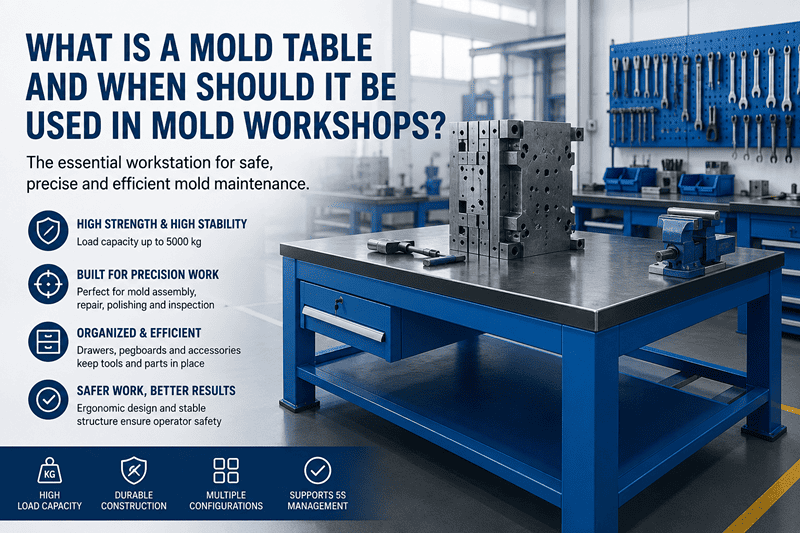
A mold table is a high-strength, stable workstation built specifically for mold assembly, repair, polishing, and cleaning. It provides a secure, purpose-built foundation for all mold-related tasks, making it an essential piece of equipment for any modern manufacturing or repair workshop that handles molds.
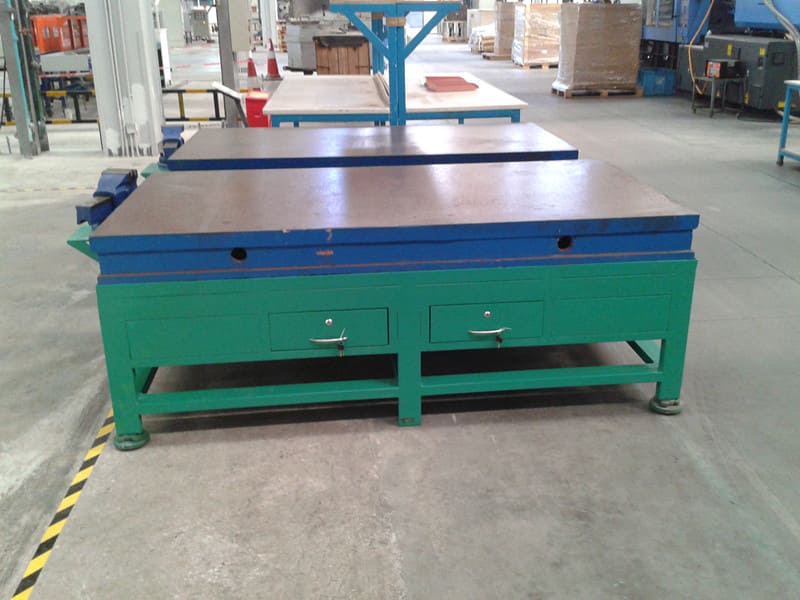
This piece of equipment might look like a simple, heavy-duty table, but it’s much more than that. In my years of experience outfitting workshops, I've seen firsthand how the right workstation can completely change a company's workflow. It’s the difference between a chaotic, slow process and a streamlined, safe, and efficient operation. A proper mold table is the foundation for quality work, and in this post, I'll explain exactly why it's so critical.
Why Is a Mold Table Essential for Mold Assembly, Repair, and Maintenance?
Performing complex mold work on the wrong surface leads to mistakes and damage. You can't achieve precision when your workspace is unstable. A dedicated mold table provides the solid, reliable platform you need.
A mold table is essential because it offers a high-load capacity and a perfectly stable surface for precise work. It prevents damage to expensive molds, ensures the safety of technicians, and creates an organized environment for assembly, repair, and regular maintenance, which are critical tasks.
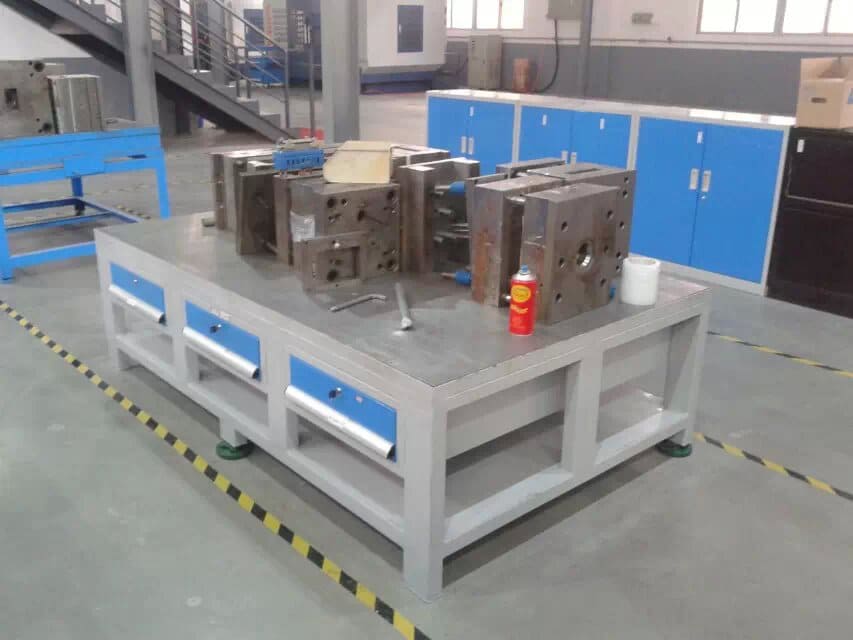
When we talk to mold engineers and workshop managers, their challenges are often the same. They handle components that are both incredibly heavy and require millimeter-level precision.1 A standard workbench just isn't built for that. Let's look at the specific tasks where a mold table becomes indispensable.
Mold Assembly and Debugging
This is where all the precision parts come together. Technicians use engineering drawings to assemble mold cores, inserts, sliders, and other components. These parts can weigh hundreds of kilograms.2 The table must be perfectly flat and stable to ensure everything aligns correctly. Any vibration or wobble could lead to misalignment3, causing defects in the final product. A mold table provides that rock-solid base, allowing for accurate assembly and debugging before the mold even goes into a machine.
Mold Repair and Polishing
Molds wear down over time.4 Repairing them involves tasks like grinding, welding, and polishing damaged surfaces.5 We often call this mold maintenance. These activities create significant force and vibration. A standard table would shake, making precise polishing impossible and creating a safety hazard. A heavy-duty mold table, with its welded steel frame, absorbs these forces. It allows technicians to securely fix the mold, often with a bench vise, and perform delicate repairs with confidence.
Mold Cleaning and Maintenance
After a production run, molds need to be disassembled and cleaned.6 This involves removing oil, plastic residue, and other debris. The table’s surface must be able to withstand harsh cleaning agents without corroding or getting damaged. After cleaning, technicians apply rust-preventative oils to protect the mold.7 A dedicated station with a durable top like stainless steel or A3 steel makes this process faster and more effective, extending the mold's service life.
What Features Should a Heavy-Duty Mold Table Have for Industrial Mold Workshops?
Not all workbenches can handle heavy molds. Choosing the wrong one risks catastrophic failure, equipment damage, and serious injury. You need to know the specific features that define a true heavy-duty mold table.
A proper heavy-duty mold table must have a high load capacity, typically over 1000 kg. It needs a strong, welded steel frame for stability and offers various durable worktop options like A3 steel or stainless steel to suit different tasks and industries.
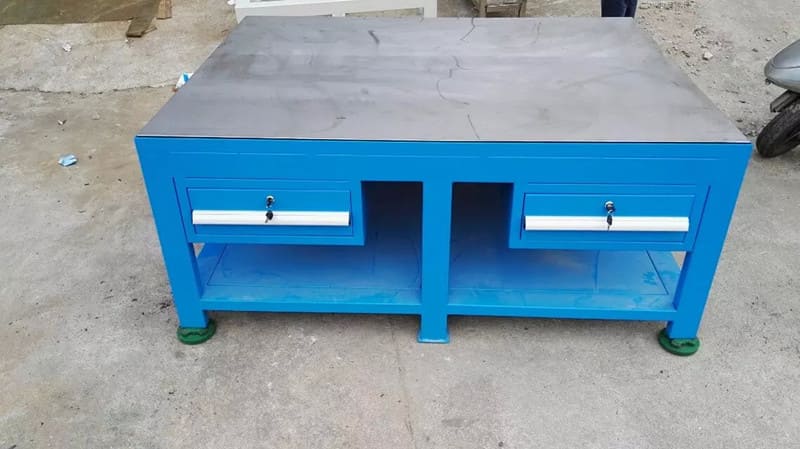
Over the years, we've refined our designs based on feedback from people who use these tables every day. A few core features consistently stand out as non-negotiable for any serious mold workshop.
Key Features of a Mold Table
| Feature | Description | Why It's Important |
|---|---|---|
| High Load Capacity | The ability to support loads from 1000 kg up to 5000 kg. | Molds are extremely dense and heavy.8 The table must support the full weight without any risk of bending or collapsing, ensuring operator safety. |
| Strong Frame | The frame is usually welded from heavy-gauge, cold-rolled steel or square steel tubing. | A welded structure provides superior stability and prevents shaking during heavy work like hammering or grinding9, which is crucial for precision. |
| Durable Worktops | Various material options are available, such as A3/45# steel plate, stainless steel, or anti-static panels. | A3 Steel is great for general repair. Stainless Steel is ideal for clean environments or when using chemicals. Anti-static tops are essential for electronics molds. |
| Flexible Configurations | Optional add-ons like drawers, hanging cabinets, pegboards, and bench vises. | These accessories help organize tools and parts, keeping the workspace tidy and efficient. A bench vise is critical for holding mold components securely during repair. |
| Safety and Ergonomics | Features like rounded corners, anti-slip surfaces, and an ergonomic working height. | These details reduce the risk of injury from sharp edges or slips. A comfortable working height minimizes strain on technicians during long hours of detailed work. |
These features aren't just nice to have; they are essential for creating a functional and safe workspace. The ability to customize the table with different tops and accessories means you can create a station perfectly tailored to your specific needs, whether you're working on small electronic molds or massive automotive molds.
How Does a Mold Table Improve Safety, 5S Management, and Working Efficiency in Mold Workshops?
A messy and disorganized workshop is an unsafe and slow workshop. Clutter leads to accidents, lost tools, and wasted hours. A properly equipped mold table is a simple solution to these common problems.
A mold table directly improves safety with its stable design and ergonomic features. It supports 5S principles by providing organized storage, which in turn boosts efficiency. Technicians work faster and more accurately when their workspace is safe, clean, and everything has its place.
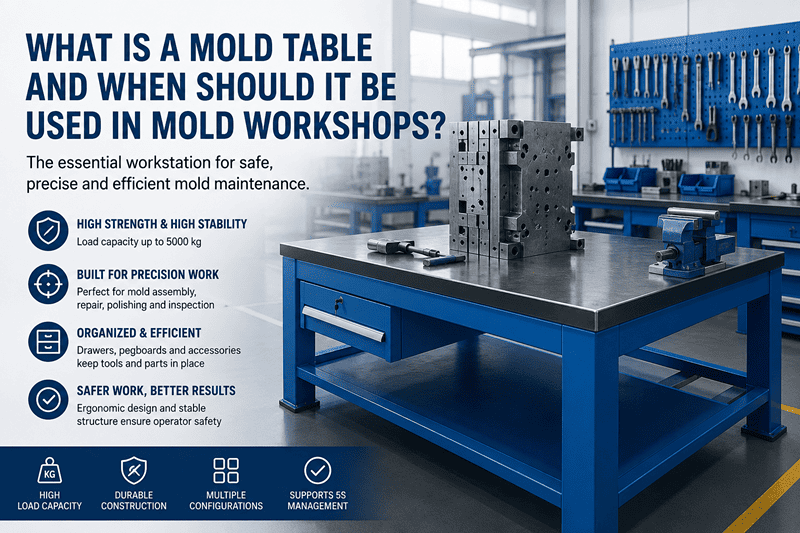
I've visited hundreds of facilities, and the most productive ones always have one thing in common: they are incredibly organized. A mold table is a cornerstone of this organization. It's not just a piece of furniture; it's a tool for implementing better work practices.
Supporting Safety and 5S Principles
The 5S methodology is a system for creating a clean, organized, and high-performance workplace.10 Here is how a mold table directly supports each step:
- Sort (Seiri): A designated workspace makes it easy to see what is needed and what is not. Unnecessary tools or parts stand out on a clean table and can be removed, reducing clutter.
- Set in Order (Seiton): This is where a mold table truly shines. With integrated drawers, cabinets, and pegboards, you can create a specific home for every tool, screw, and measuring device. This eliminates time wasted searching for items.11
- Shine (Seiso): The durable, smooth surfaces of a mold table (like steel or stainless steel) are easy to wipe down. Regular cleaning becomes a quick, simple task, preventing the buildup of grease and metal shavings.
- Standardize (Seiketsu): By equipping your workshop with standardized mold tables, you create a consistent process for all maintenance tasks. Every technician knows where to find tools and how to keep their station, which improves consistency and quality.
- Sustain (Shitsuke): An organized and easy-to-maintain workspace is much easier to keep that way. The mold table makes it simple to maintain the discipline of 5S over the long term.
Boosting Efficiency and Accuracy
When a workshop is safe and organized, efficiency naturally follows. Technicians don't have to worry about the table collapsing, so they can focus on their work. They don't waste time looking for a 10mm wrench because it's in its designated drawer. Pre-trial mold inspections become faster because all necessary tools are at hand. The stable surface allows for more accurate polishing and assembly, reducing the chance of errors that lead to costly rework. It's a simple equation: a better workspace leads to better, faster work.
Conclusion
A mold table is not just a heavy-duty bench; it's a fundamental investment in your workshop's safety, efficiency, and quality control. It provides the stability and organization needed for high-precision work.
"Multi-Objective Optimization of an Injection Molding Process for an ...", https://pmc.ncbi.nlm.nih.gov/articles/PMC12473918/. Engineering literature on injection-mold manufacture describes tight dimensional tolerances for mold components, supporting the claim that mold work requires precise alignment; the source may discuss tolerances generally rather than the specific workshop operations in this article. Evidence role: general_support; source type: paper. Supports: Mold components and mold assembly tasks require high dimensional precision.. Scope note: Contextual support; tolerance requirements vary by mold type, material, and part specification. ↩
"[PDF] An Environmental Analysis of Injection Molding - MIT", https://web.mit.edu/ebm/Publications/Thiriez_ISEE_2006.pdf. A technical reference on injection molds reports that large mold assemblies can weigh hundreds of kilograms or more, supporting the plausibility of heavy mold components; it does not prove the weight of every core, insert, or slider. Evidence role: general_support; source type: education. Supports: Mold parts such as cores, inserts, and sliders can be very heavy, including weights in the hundreds of kilograms.. Scope note: Contextual support; component weights differ widely by mold size, steel grade, and application. ↩
"Dimensional Accuracy and Measurement Variability in CNC-Turned ...", https://pmc.ncbi.nlm.nih.gov/articles/PMC12194426/. Manufacturing engineering research links fixture or machine vibration with reduced dimensional accuracy and alignment errors, supporting the mechanism by which an unstable work surface can contribute to misalignment; the evidence is general to precision manufacturing rather than specific to mold tables. Evidence role: mechanism; source type: paper. Supports: Vibration or wobble during mold assembly can contribute to misalignment.. Scope note: Indirect support; the source may address machining or fixturing vibration rather than mold-table use specifically. ↩
"Cycle-Based Control of Injection Moulding Process in Presence of ...", https://pmc.ncbi.nlm.nih.gov/articles/PMC11243958/. Peer-reviewed studies of injection-mold wear document that repeated molding cycles and abrasive materials can degrade mold surfaces over service life, supporting the general claim that molds wear over time. Evidence role: mechanism; source type: paper. Supports: Molds experience wear and degradation during repeated use.. Scope note: Wear rates depend on polymer type, fillers, mold material, surface treatment, and operating conditions. ↩
"(PDF) Handbook of mold, tool and die repair welding - Academia.edu", https://www.academia.edu/9626902/Handbook_of_mold_tool_and_die_repair_welding. Technical literature on mold repair identifies welding, grinding, and polishing as restoration methods for damaged mold surfaces, supporting the listed repair operations; practices vary with damage type and mold material. Evidence role: general_support; source type: paper. Supports: Grinding, welding, and polishing are recognized operations used in mold repair.. Scope note: The source may describe common repair methods but not prescribe them for all mold-damage cases. ↩
"[PDF] ENGEL INJECTION MOLDING MAINTENANCE MANUAL", https://beta.centralseminary.edu/virtual-library/gJefpX/4FE082/engel_injection-molding-maintenance__manual.pdf. Preventive-maintenance guidance for injection molds describes periodic disassembly and cleaning to remove residues and inspect components, supporting the maintenance claim; the exact interval depends on production volume and material processed. Evidence role: general_support; source type: institution. Supports: Molds commonly require disassembly and cleaning as part of maintenance after production use.. Scope note: Maintenance frequency and scope vary by mold design, resin, and production environment. ↩
"[PDF] Coatings for corrosion protection - NIST Technical Series Publications", https://nvlpubs.nist.gov/nistpubs/Legacy/SP/nistspecialpublication1035.pdf. Corrosion-control literature explains that protective oils and corrosion inhibitors reduce steel oxidation by forming a barrier against moisture and oxygen, supporting the use of rust-preventive oils for steel molds. Evidence role: mechanism; source type: paper. Supports: Rust-preventative oils can protect steel molds from corrosion.. Scope note: General corrosion evidence; performance depends on oil formulation, storage conditions, and mold-steel composition. ↩
"Tool steel - Wikipedia", https://en.wikipedia.org/wiki/Tool_steel. Materials references list tool steels at densities around 7.7–7.9 g/cm³, supporting the statement that steel molds are made from dense materials; this does not by itself determine the final weight of a particular mold. Evidence role: general_support; source type: encyclopedia. Supports: Steel molds are heavy partly because common mold steels are high-density materials.. Scope note: Supports material density rather than total mold mass, which also depends on mold volume and design. ↩
"Vibration and deflection characteristics of semi-rigid jointed frames", https://ui.adsabs.harvard.edu/abs/1997EngSt..19.1001P/abstract. Structural engineering references describe welded steel frames as rigid moment-resisting connections that can improve frame stiffness, supporting the stability rationale; the source may not evaluate mold-table designs directly. Evidence role: mechanism; source type: education. Supports: A welded steel frame can improve stiffness and reduce movement during forceful workshop tasks.. Scope note: Contextual support; actual vibration resistance depends on frame geometry, weld quality, steel section size, and floor anchoring. ↩
"[PDF] Lean and Environment Training Module 5 - 6S (5S+Safety) - EPA", https://www.epa.gov/sites/default/files/2015-06/documents/module_5_6s.pdf. Institutional lean-manufacturing guidance defines 5S as a workplace-organization method focused on sorting, ordering, cleaning, standardizing, and sustaining work areas, supporting the article’s description of 5S. Evidence role: definition; source type: institution. Supports: 5S is a workplace-organization system intended to create clean and orderly work environments.. Scope note: The source defines the method; performance outcomes depend on implementation quality and workplace context. ↩
"[PDF] Organizing the Workplace to Maximize Productivity", https://tmep.cis.tennessee.edu/sites/default/files/2022-11/UT%20CIS%205S%20Workplace%20Organization%20Resource%20Guide.pdf. Studies and institutional reports on 5S implementation find reductions in search time and improvements in workplace organization, supporting the claim that assigned locations for tools can reduce time spent looking for items. Evidence role: statistic; source type: paper. Supports: Organized storage and defined locations for tools can reduce time wasted searching for items.. Scope note: The degree of time savings varies by baseline disorder, implementation rigor, and task type. ↩