Struggling with lost screws and a chaotic workshop? This disorganization costs time and money.1 A proper parts organizer is the simple, effective solution you need for your space.
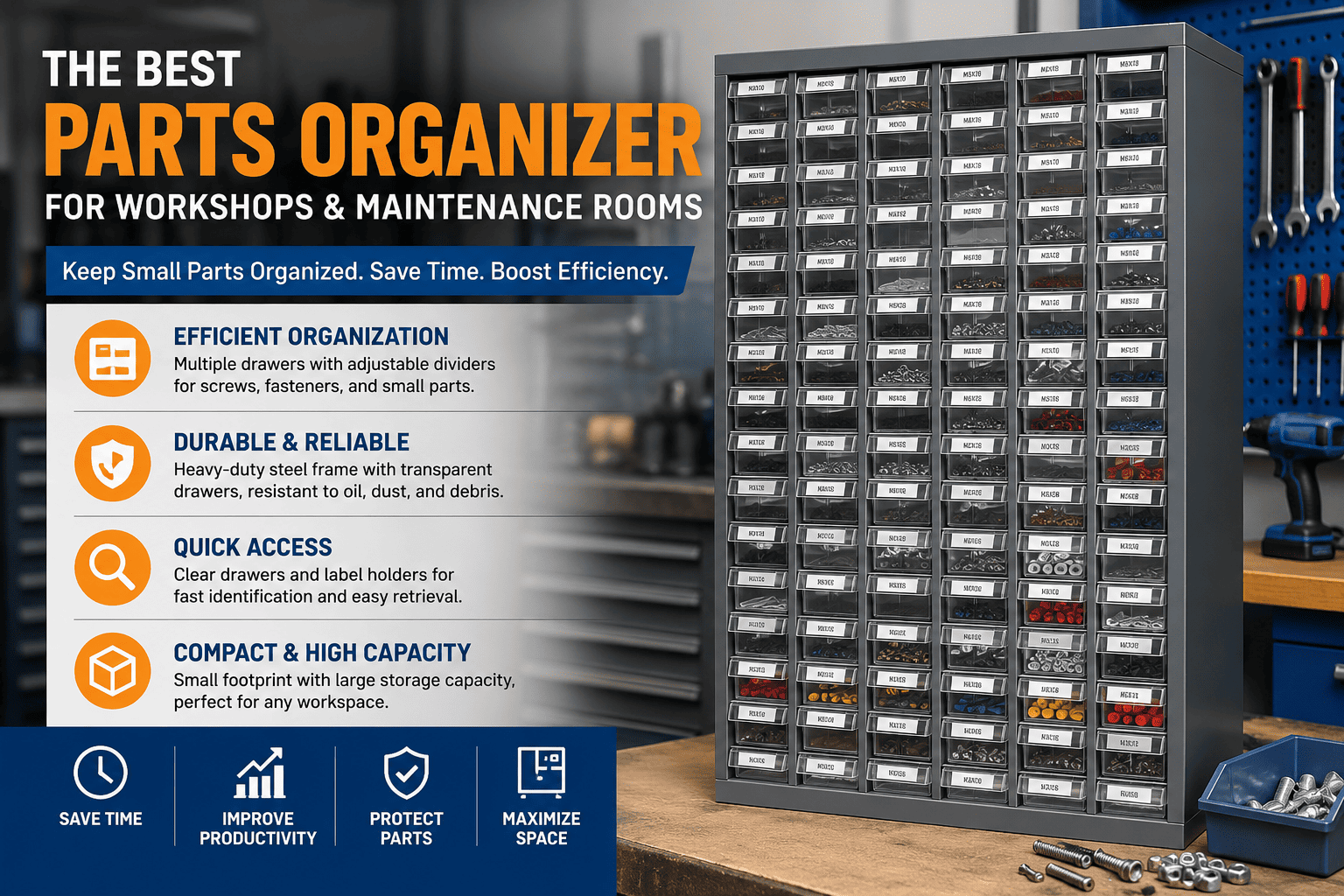
The best parts organizer for a professional workshop or maintenance room is a heavy-duty steel cabinet equipped with transparent plastic drawers. This system offers durable protection, clear visibility of contents2, and customizable compartments for screws, fasteners, and small components, keeping them secure and easily accessible.
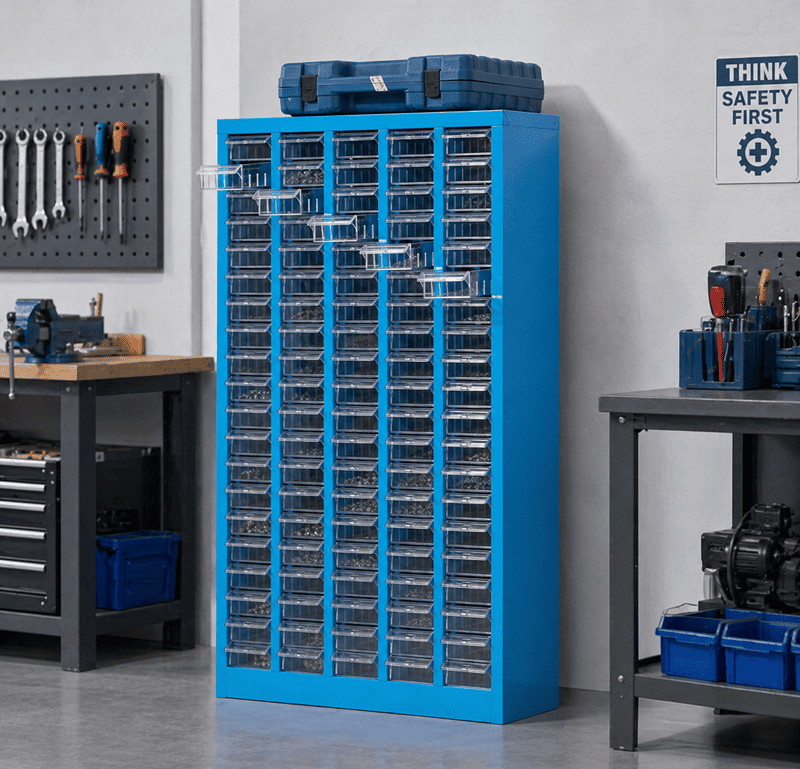
Finding the perfect system can feel overwhelming, but it is simpler than you think. I have spent years helping clients outfit their workshops, and one solution consistently stands out. This type of organizer works so well because it is built for the demanding environment of a busy facility. Let's explore why this system is the superior choice for any professional setting. We will look at how they boost efficiency and what specific features you should demand for your operation.
How Do Parts Organizers Improve Small Parts Storage Efficiency in Workshops?
Tired of wasting precious minutes searching for a single screw? This lost time quickly adds up and kills productivity. A good parts organizer gives you that time back instantly.
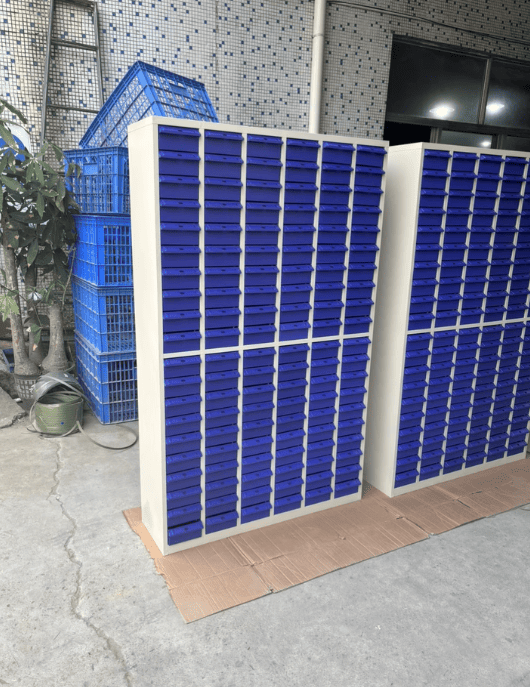
Parts organizers improve efficiency by centralizing and categorizing all your small items3. They use individual, often divisible, compartments to separate screws, bolts, and electronic components. This prevents mixing, slashes search time4, allows for quick visual inventory checks, and ensures the right part is always ready.
From Chaos to Control
The real cost of disorganization is more than just wasted time. It is about mistakes, project delays, and frustration. When a technician cannot find the right washer or fuse, they might be tempted to use a close-but-not-perfect substitute, which can lead to equipment failure down the line5. I have seen million-dollar machines go offline because of a five-cent part that could not be found. A dedicated parts organizer eliminates this guesswork. It creates a system of control where every component has a designated home. This simple change transforms a chaotic workbench into a model of efficiency, allowing your team to focus on the task at hand instead of hunting for supplies. The workflow becomes smoother and more predictable.
The Real Cost of Searching
Think about the true cost of searching for a part. If a mechanic earning $30 an hour spends just 10 minutes per day searching for parts, that adds up to over $1,200 in lost productivity per year6 for that one employee. Now multiply that across your entire team. A well-organized parts cabinet turns that search time into productive work time.
| Metric | Without Organizer | With Organizer |
|---|---|---|
| Search Time | 5-10 minutes per part | Less than 30 seconds |
| Inventory Check | Difficult, inaccurate, time-consuming | Quick and accurate visual scan |
| Part Loss/Mixing | High, frequent | Minimal to none |
| Workflow | Constantly interrupted and delayed | Smooth and continuous |
What Features Should You Look for in a Workshop Parts Organizer?
Have you ever bought a parts organizer that cracked and failed? Cheap plastic solutions just cannot handle workshop demands. You need to focus on industrial-grade features to ensure your investment lasts.
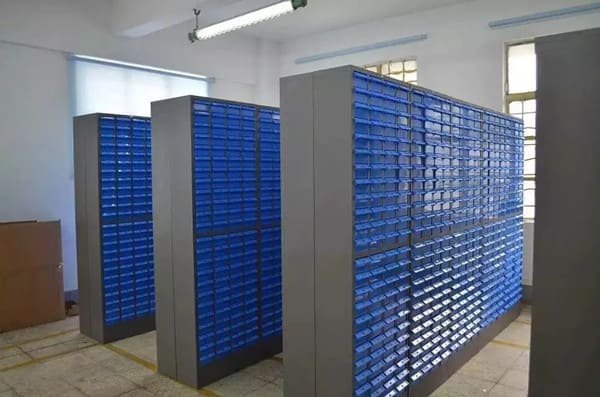
Look for a heavy-duty steel frame, transparent and impact-resistant drawers, and adjustable dividers. These features provide durability, quick visual identification of contents, and flexible storage. Also, ensure it has a secure drawer-stop mechanism and built-in label holders for maximum organization and safety.
Material Matters: Steel and High-Impact Plastic
In my experience, the number one point of failure for cheap organizers is the material. A workshop is a tough place. It has oils, chemicals, temperature changes, and the occasional bump from a heavy cart. That is why I always tell my clients to prioritize a cabinet with a robust, powder-coated steel frame7. The steel provides the structural integrity to hold significant weight and resist dents and corrosion8. For the drawers, you do not want brittle, clear plastic. You need high-impact, transparent plastic like PS (Polystyrene) or ABS9. This type of plastic is resistant to cracking10 and remains clear even when exposed to workshop grime, so you can see what is inside without opening every drawer.
Functionality in Design
Beyond materials, the design of the organizer is critical for daily use. A key feature is a drawer stop11. This small design element prevents drawers from being pulled out completely by accident, which would spill dozens or hundreds of tiny parts all over the floor. I have seen it happen, and it is a nightmare to clean up. Another essential feature is built-in label holders on the front of each drawer. Clear visibility is great, but for ultimate speed, you need clear labels. This allows anyone, even a new employee, to find the exact M6 bolt or 10-ohm resistor they need in seconds.
| Feature | Why It Is Important |
|---|---|
| Steel Cabinet/Frame | Resists dents, oils, and chemicals; provides structural stability for stacking. |
| Transparent Drawers | Allows instant visual identification of parts without opening drawers. |
| Adjustable Dividers | Customizes drawer space for different sized components, maximizing density. |
| Drawer Stop/Lock | Prevents drawers from accidentally falling out and spilling contents. |
| Label Holder | Enables clear, systematic labeling for the fastest possible retrieval. |
Why Are Drawer-Based Parts Organizers Better Than Open Bins and Shelves?
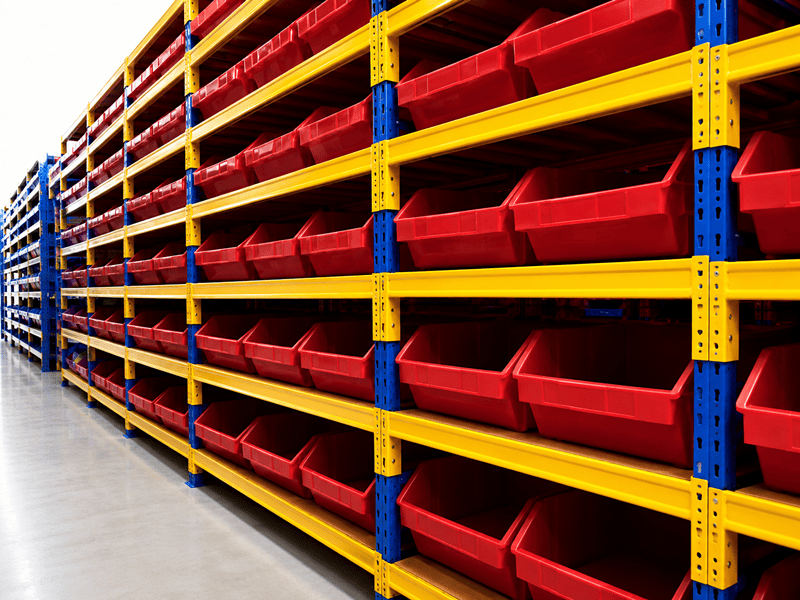
Are you still using open bins to store your small parts? They seem like a good idea at first, but they attract dust, debris, and create a visual mess. This exposure can damage sensitive components.
Drawer-based organizers are better because they completely enclose and protect parts from workshop dust, dirt, and moisture. Unlike open bins, drawers keep contents clean and secure. They prevent accidental spills, offer much higher storage density in a smaller footprint, and provide a neater, more professional appearance.
Protection from the Environment
A workshop is not a clean room. Dust, metal shavings, and moisture are everywhere.12 I once visited a client's facility where they kept thousands of dollars in electronic components stored in open-top bins. A coolant line had sprayed overnight, and every single component was contaminated and ruined. That entire loss would have been prevented with a simple enclosed drawer cabinet. The drawers act as individual protective cases for your inventory. They seal out the contaminants that can cause corrosion on metal parts or short circuits in electronic components. This protection is not a luxury; it is essential for maintaining the quality and reliability of your spare parts inventory.
Maximizing Your Valuable Space
Real estate in a workshop or on a factory floor is expensive. You need to make every square foot count. Open bins on shelves are incredibly inefficient from a space perspective. There is wasted air above each bin and between each shelf. A drawer cabinet, on the other hand, offers incredible storage density. You can store thousands of different small parts in a unit that takes up only a few square feet of floor space. Because the drawers are divisible, you can customize the interior of each one to hold exactly what you need without wasting an inch. This high-density approach frees up valuable floor and wall space for larger equipment and workflow.
| Aspect | Drawer Organizer (Cabinet) | Open Bins on Shelves |
|---|---|---|
| Protection | Excellent (enclosed from dust, debris, spills) | Poor (open to the environment) |
| Space Efficiency | High (dense storage in a compact unit) | Low (wasted space between bins and shelves) |
| Organization | High (fixed compartments, labels, no mixing) | Medium (parts get mixed, bins get moved) |
| Security | Good (prevents accidental spills and loss) | Poor (items can be easily knocked over) |
Conclusion
In summary, a steel cabinet with transparent drawers is the best investment for workshop efficiency. It protects parts, saves space, and eliminates wasted time, making your work easier.
"5S methodology prepares students for workforce", https://cdme.osu.edu/news/2025/04/5s-methodology-prepares-students-workforce. Research on workplace organization and lean/5S practices links poor organization with wasted motion, search time, and reduced operational efficiency; this supports the general productivity rationale but does not quantify losses for this specific workshop. Evidence role: general_support; source type: paper. Supports: Workshop disorganization costs time and money.. Scope note: Contextual support; the magnitude of cost depends on the facility, labor rate, and workflow. ↩
"[PDF] 5 PILLARS OF THE VISUAL WORKPLACE", https://campaigns.dmu.edu/Resources/GoXmwc/6AD220/5__pillars_of__the-visual__workplace.pdf. Studies and guidance on visual management in lean systems describe how visible storage and labeling can reduce information-seeking effort and support faster identification of needed materials; this supports the visibility rationale but not the superiority of any specific organizer model. Evidence role: mechanism; source type: paper. Supports: Transparent drawers improve parts retrieval by making contents visible.. Scope note: Supports the mechanism of visual identification rather than proving one product type is universally best. ↩
"5S Workplace Organization for Tennessee Manufacturers", https://tmep.cis.tennessee.edu/5s-workplace-organization. Lean 5S literature identifies set-in-order practices—assigning fixed locations and categories for tools and materials—as a method for reducing search and handling waste; this supports the organizational principle but is not specific to screws or fasteners. Evidence role: expert_consensus; source type: paper. Supports: Centralizing and categorizing small items improves workshop storage efficiency.. Scope note: General operational-management support, not a direct test of parts cabinets. ↩
"[PDF] Information organization and retrieval - Clemson Blogs", http://blogs.clemson.edu/catlab/files/2021/09/Pak-et-al.-2007-Information-organization-and-retrieval-A-comparison-of-taxonomical-and-tagging-systems.pdf. Empirical and review literature on 5S implementation commonly reports reduced searching and retrieval time after systematic sorting, labeling, and location control; this supports the direction of the claim, though exact time savings vary by setting. Evidence role: statistic; source type: paper. Supports: Organized compartments and labeling can reduce the time workers spend searching for parts.. Scope note: The source may provide case-specific reductions rather than a universal percentage or duration. ↩
"Strategical selection of maintenance type under different conditions", https://pmc.ncbi.nlm.nih.gov/articles/PMC10511507/. Reliability and maintenance references note that improper replacement parts, incorrect specifications, or unsuitable components can compromise equipment reliability and contribute to failures; this supports the risk mechanism but not the article’s anecdotal example. Evidence role: mechanism; source type: institution. Supports: Using a close-but-not-correct substitute part can contribute to later equipment failure.. Scope note: Contextual support; the actual failure risk depends on the equipment, component tolerance, and operating conditions. ↩
"Automotive Service Technicians and Mechanics", https://www.bls.gov/ooh/installation-maintenance-and-repair/automotive-service-technicians-and-mechanics.htm. Bureau of Labor Statistics wage data can contextualize the assumed hourly rate for mechanics, while the annual loss figure follows arithmetically from the stated time assumption; the citation supports the wage context rather than directly measuring search-related losses. Evidence role: statistic; source type: government. Supports: A mechanic wage assumption near $30 per hour can make daily search time translate into substantial annual labor cost.. Scope note: The productivity-loss calculation is hypothetical and depends on workdays per year and actual wage rates. ↩
"Accelerated Corrosion Tests in Quality Labels for Powder Coatings ...", https://pmc.ncbi.nlm.nih.gov/articles/PMC8585214/. Materials and coatings references describe powder coating as a protective finish used to improve corrosion and wear resistance on metal substrates; this supports the durability rationale for a powder-coated steel frame but does not establish performance for every cabinet design. Evidence role: mechanism; source type: research. Supports: A powder-coated steel frame can improve durability and corrosion resistance in workshop storage equipment.. Scope note: Performance varies with coating thickness, surface preparation, steel grade, and exposure conditions. ↩
"Corrosion-Resistant Steel: What's the Best Recipe? – Catalyst", https://wp.wpi.edu/catalyst/2016/07/02/corrosion-resistant-steel-whats-the-best-recipe/. Engineering materials references characterize steel as a high-strength structural material and discuss corrosion protection requirements for steel in service environments; this supports the general claim about structural robustness, with corrosion resistance depending on coating or alloy selection. Evidence role: mechanism; source type: education. Supports: Steel frames can provide structural strength, while corrosion resistance depends on protective treatment.. Scope note: Plain carbon steel can corrode without protective coatings; the claim is strongest when tied to coated or stainless steel. ↩
"[PDF] Polystyrene and Styrolux®", https://zeus.phys.uconn.edu/wiki/images/Polystyrene_properties.pdf. Polymer materials references describe ABS and high-impact polystyrene as impact-modified thermoplastics used where toughness and molded transparency or appearance are relevant; this supports the material-selection rationale but not all grades are transparent or equally chemical resistant. Evidence role: definition; source type: education. Supports: High-impact polystyrene and ABS are plastics commonly selected for toughness in molded parts such as drawers.. Scope note: Material properties vary substantially by grade, additives, and exposure to solvents or UV light. ↩
"ABS Plastic Properties | View Tensile Strength & Impact Resistance ...", https://www.curbellplastics.com/materials/plastics/abs/?srsltid=AfmBOori6XR3p4r4juo0hfFFeYSUzTFP5pKp02Wce8DApuWEUnFUuDeM. Materials data for ABS and high-impact polystyrene report higher impact strength than brittle general-purpose plastics, supporting the claim that impact-modified plastics can resist cracking under ordinary handling; this does not guarantee resistance under heavy loads or chemical exposure. Evidence role: mechanism; source type: research. Supports: Impact-modified plastics used in organizer drawers can be more resistant to cracking than brittle plastics.. Scope note: Crack resistance depends on formulation, temperature, load, aging, and chemical contact. ↩
"[PDF] Slips Trips Falls Hand out for Safety Committee Meetings - OSHA", https://www.osha.gov/sites/default/files/2018-12/fy16_sh-29672-sh6_SlipsTripsFallsHandoutforSafetyCommitteeMeetings.pdf. Workplace safety guidance on housekeeping and material storage emphasizes preventing objects from falling, spilling, or creating slip and trip hazards; this supports the safety rationale for drawer stops, although it is not specific to parts-organizer design. Evidence role: general_support; source type: government. Supports: Drawer stops can help prevent accidental spills and related housekeeping hazards.. Scope note: Provides general safety principles rather than a product-specific test of drawer-stop mechanisms. ↩
"Metalworking Fluids | NIOSH - CDC Archive", https://archive.cdc.gov/www_cdc_gov/niosh/topics/metalworking/default.html. Occupational and industrial-hygiene sources document that machining and workshop activities can generate metalworking dusts, chips, aerosols, and moisture-related contaminants; this supports the environmental-exposure premise but not conditions in every workshop. Evidence role: general_support; source type: government. Supports: Workshops can contain dust, metal shavings, moisture, and other contaminants that may affect stored parts.. Scope note: Exposure levels vary by process, ventilation, cleaning practices, and facility type. ↩