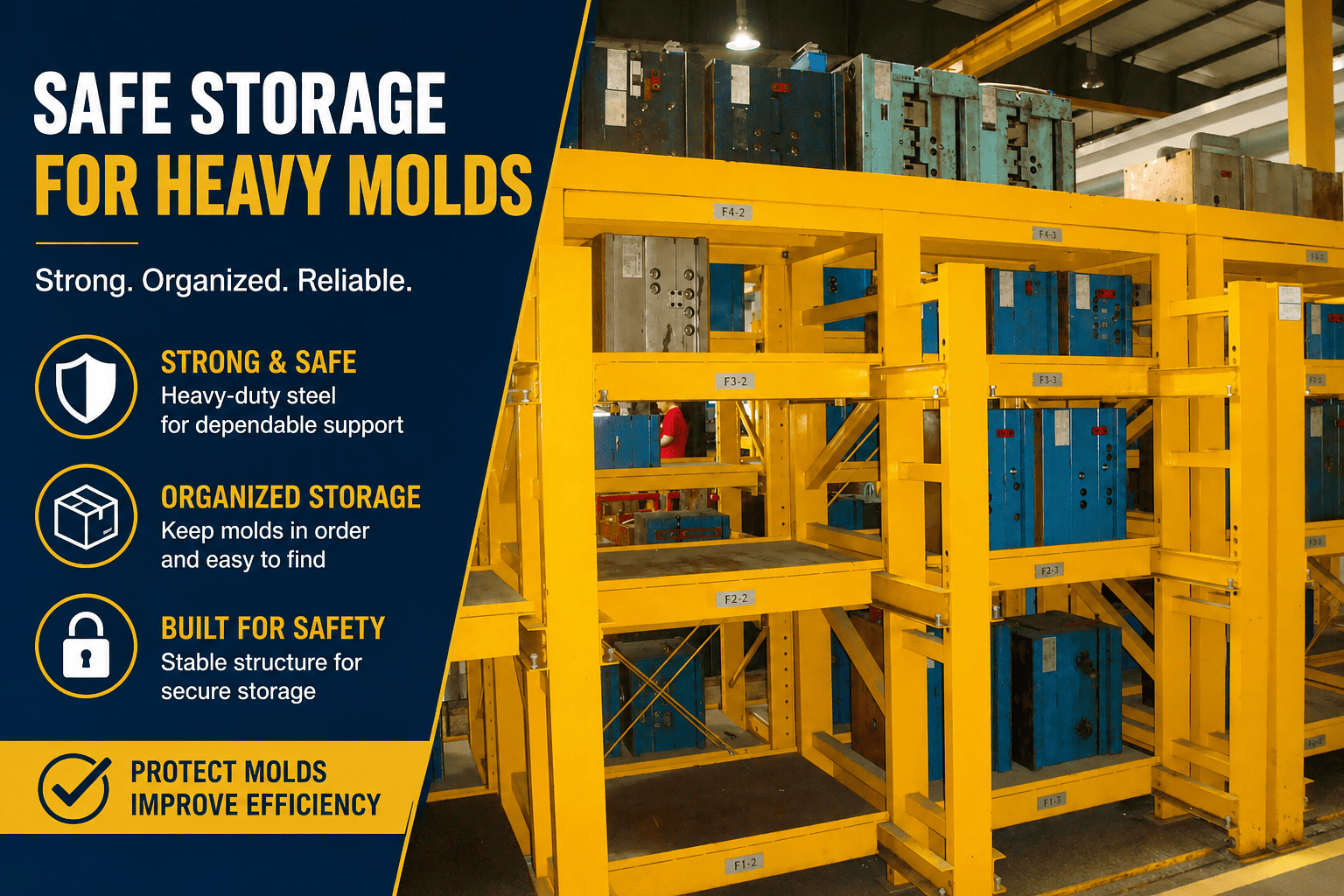
How Do You Choose the Right Mold Shelf for Storing Heavy Molds Safely? Worried about storing heavy molds? A collapse could be disastrous for your equipment and team1. Choosing the right mold shelf is crucial for safety and efficiency in your workshop.
To choose the right mold shelf, first calculate the maximum weight of your molds and select a rack with a higher load capacity. Prioritize high-strength steel with a protective finish. Finally, ensure the design features safety mechanisms and optimizes your available workshop space for efficiency.
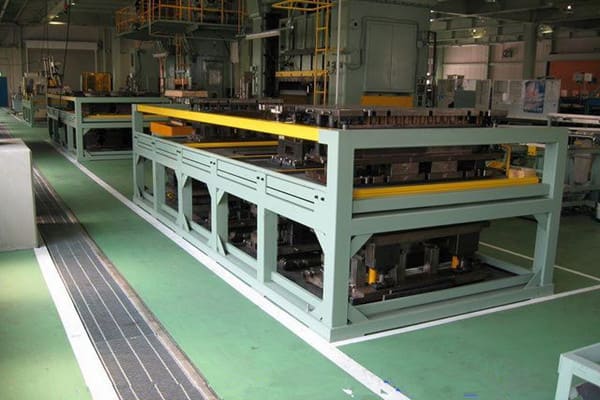
Getting the basics right is a great start. But the details are what really matter, especially when we are talking about tons of steel in your workshop. Let's break down exactly what you need to consider to make a truly safe and smart investment in your operations.
How Do You Calculate the Right Load Capacity for Heavy Mold Shelves Without Safety Risks?
Guessing your shelf's load capacity is a huge risk. A miscalculation can lead to catastrophic failure, damaging expensive molds and endangering your staff. Let's calculate it safely together.
To calculate the right load capacity, first identify the weight of your heaviest mold. Then, choose a shelf with a capacity rating that is significantly higher than this weight. Always factor in dynamic load2s from handling equipment like forklifts to ensure a robust safety margin.
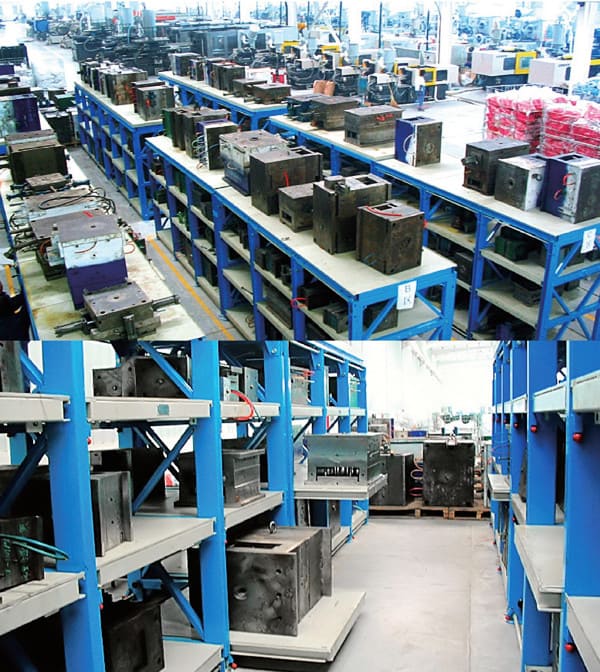
Calculating the right load capacity is the most critical step for ensuring safety. It’s not just about knowing the weight of your heaviest mold, although that is the starting point. You need to consider both static and dynamic loads to get the full picture.
Static vs. Dynamic Loads
A static load3 is simply the weight of the mold sitting still on the shelf. A dynamic load, however, includes the additional forces applied during handling. When a forklift places a mold onto the shelf, the impact, however slight, momentarily increases the force on the shelf structure. Ignoring this can lead to long-term stress and potential failure. A good rule of thumb is to always choose a shelf with a capacity that comfortably exceeds your heaviest mold's weight.
The Safety Margin Rule
We always recommend a safety margin of at least 25%4. This buffer accounts for dynamic loads and prevents you from ever operating at the shelf’s absolute limit. Here is a simple guide:
| Mold Weight Range | Recommended Shelf Level Capacity |
|---|---|
| Up to 800 kg | 1 Ton (1000 kg) |
| 801 kg - 1600 kg | 2 Tons (2000 kg) |
| 1601 kg - 2400 kg | 3 Tons (3000 kg) |
| 2401 kg - 3200 kg | 4 Tons (4000 kg) |
This structured approach removes guesswork and puts safety first. Never max out the stated capacity of your shelves.
What Features Should a Heavy-Duty Mold Shelf Have for Long-Term Industrial Use?
A cheap mold shelf seems tempting, but rust and warping will quickly turn it into a liability5. True value comes from features that guarantee durability and long-term safety for years.
A heavy-duty mold shelf must be made from high-strength steel, like Q235B, for durability. Look for a protective surface treatment, such as powder coating or galvanizing6 for humid areas. Essential features include safety locks on drawers and a robust, bolt-connected structure for stability.
A shelf built for industrial use needs to be tough from its core material to its smallest component. When I talk to clients, I emphasize that the initial investment in quality features pays for itself through longevity and safety.
The Foundation: Material and Finish
The life of a mold shelf starts with its material. We use high-quality Q235B steel7 because it has the strength and toughness to handle constant heavy loads without deforming. But raw steel is vulnerable. The surface finish is critical for protection. Here’s a quick comparison of the two best options:
| Feature | Electrostatic Powder Coating | Galvanized Finishing |
|---|---|---|
| Best For | General industrial environments | Humid or corrosive environments |
| Protection | Resists scratches, wear, and rust | Superior rust/corrosion resistance |
| Appearance | Smooth, uniform color | Mottled, metallic finish |
For most workshops, powder coating is excellent. But if your facility has high humidity, galvanizing is the smarter long-term choice.
Critical Safety and Design Features
Beyond materials, smart design prevents accidents. Drawer-type shelves should have safety locks or limit stops. These simple devices prevent a drawer from being pulled out too far and tipping over8, which is a major risk with heavy molds. The structure itself, often a main-frame with extension-frames, provides stability and allows for easy future expansion. For workshops using overhead cranes, a shelf with an open-top design is essential9. It provides clear access for lifting, making the process safer and more efficient. These features are not optional; they are necessary for a safe and durable industrial storage system.
How Can the Right Mold Shelf Improve Workshop Space Utilization and Mold Management Efficiency?
Is your workshop floor cluttered with molds? This chaos wastes time, risks damage, and creates safety hazards. A proper mold shelf system reclaims your space and streamlines your entire operation.
The right mold shelf maximizes vertical space, clearing your workshop floor. By assigning a specific, accessible location for each mold, you reduce search times significantly. Customizable, drawer-type shelves allow quick access, boosting mold changeover speed and overall management efficiency.
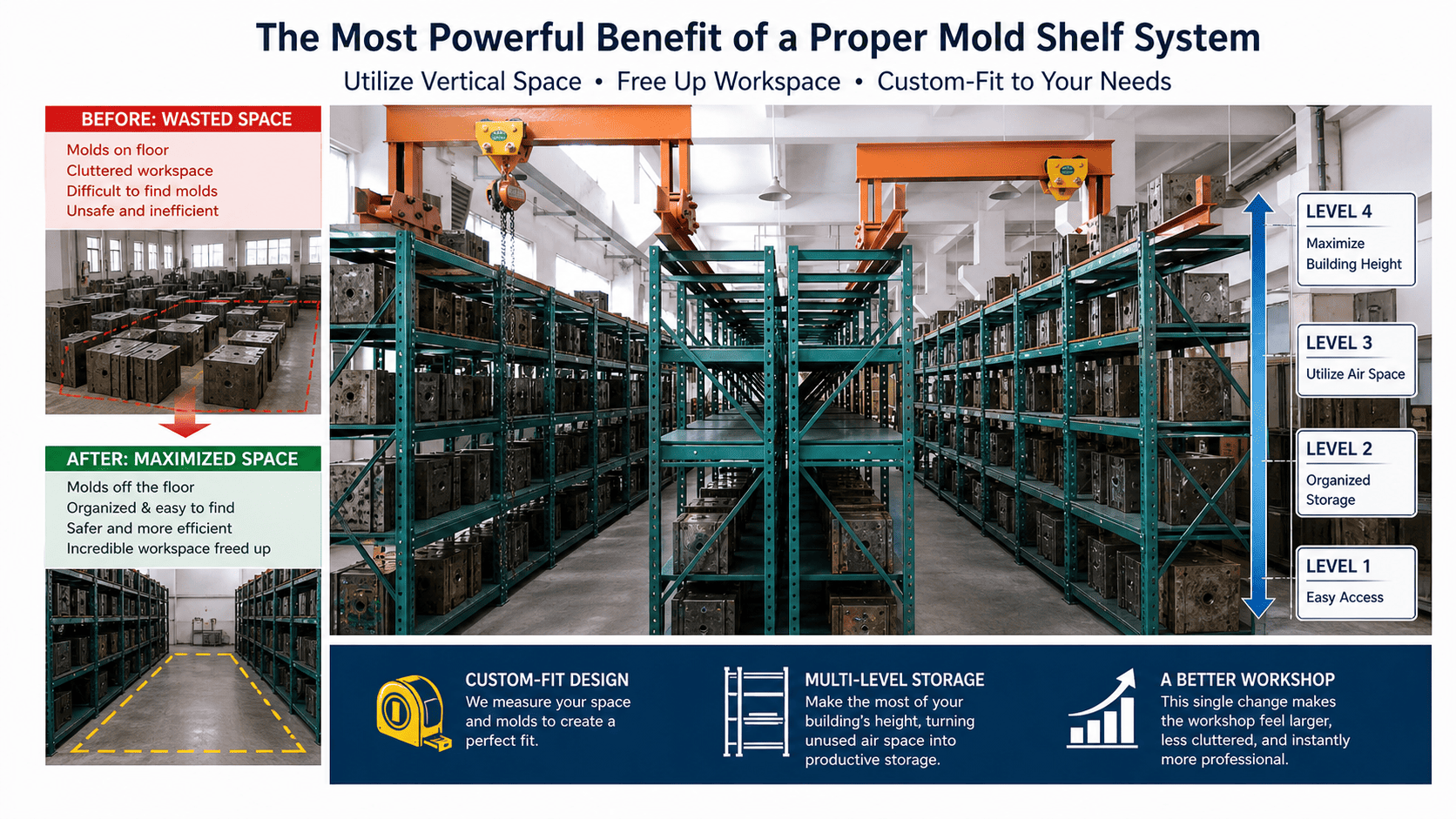
I've seen firsthand how a well-planned storage system can completely transform a workshop. It’s not just about tidiness; it's about creating a smarter, more productive, and safer work environment for everyone.
From Floor Chaos to Vertical Order
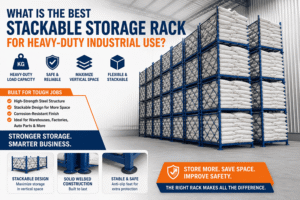
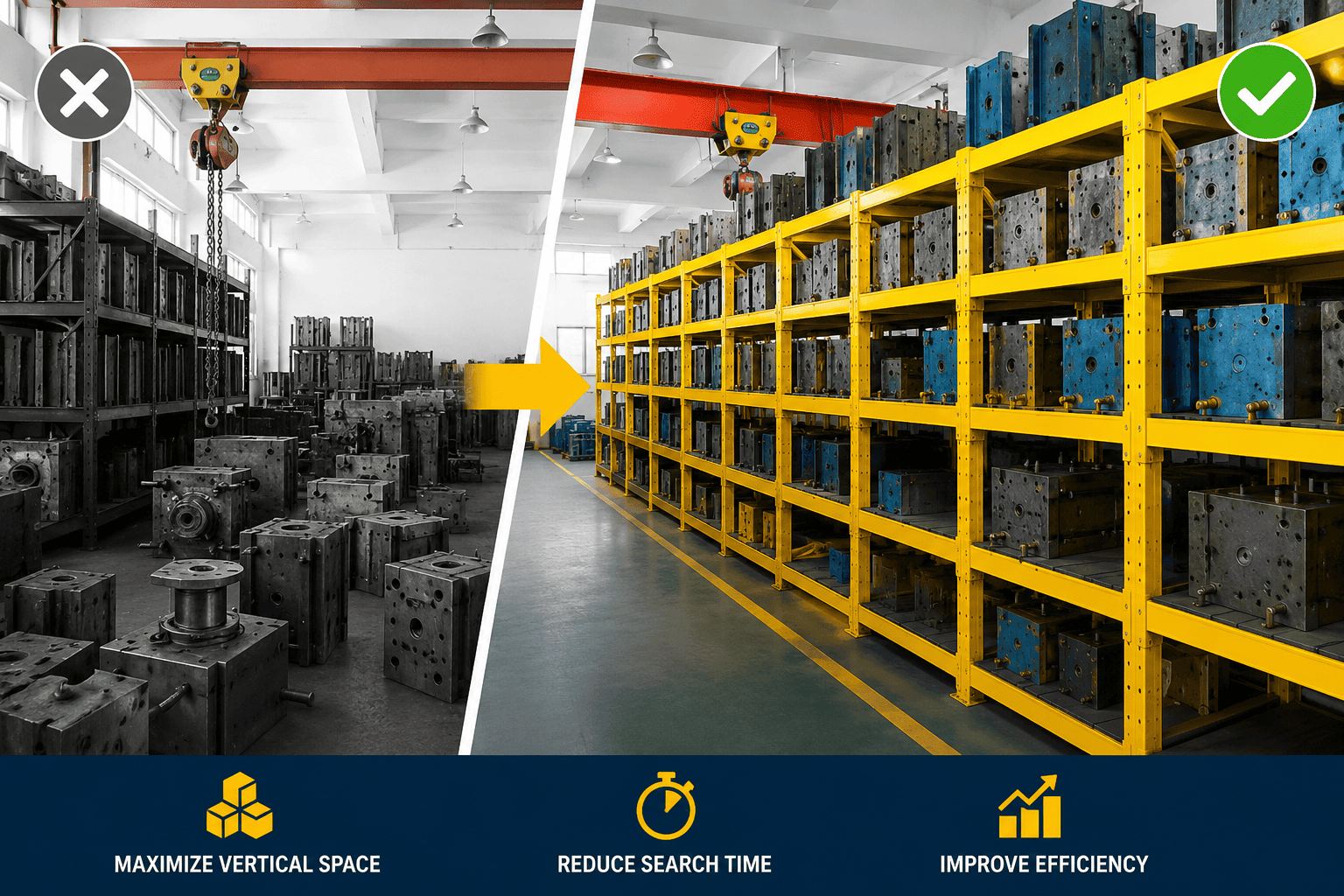
The most powerful benefit of a proper mold shelf system is its ability to utilize vertical space10. By moving heavy molds off the floor and into an organized rack, you can free up an incredible amount of valuable workspace. We design our shelves based on your specific needs. We measure your available space and your molds to create a custom-fit solution. A multi-level design makes the most of your building's height, turning previously unused air space into productive storage. This single change makes the workshop feel larger, less cluttered, and instantly more professional.
Streamlining Workflow and Inventory
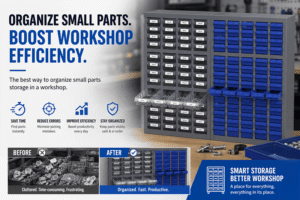
Space is only half the story. Efficiency is the other. Drawer-type shelves are a game-changer for workflow. Instead of having to move several molds to get to the one you need, an operator can simply pull out a drawer for direct access. This drastically cuts down on retrieval time11 and reduces the physical effort required for mold changes. This system also creates a foundation for better inventory management12. When every mold has a designated home, you always know what you have and where to find it. This level of organization eliminates wasted time and makes your entire production process smoother and more predictable.
Conclusion
Choosing the right mold shelf comes down to calculating capacity, selecting durable materials, and planning for efficiency. This ensures safety and boosts productivity in your workshop.
"Warehousing - Know the Law | Occupational Safety and Health ...", http://www.osha.gov/warehousing/standards-enforcement. A report from a workplace safety authority, such as OSHA, could provide statistics or case studies on injuries, fatalities, and property damage resulting from the structural failure of industrial storage racks. Evidence role: general_support; source type: government. Supports: The claim that storage rack collapses can have disastrous consequences.. ↩
"Static Loading vs. Dynamic Loading: The Surprising Forces in ...", https://www.qmhinc.com/static-loading-vs-dynamic-loading-the-surprising-forces-in-warehouses/?srsltid=AfmBOoooIJ9Jv38KMWcKYiMrk0A4A045pRW_gPDZGoshhePuES9GqVtD. An engineering textbook or university resource can define a dynamic load as a force that changes over time, such as impact or shock loads generated when placing heavy items onto a shelf with material handling equipment. Evidence role: definition; source type: education. Supports: The definition of a dynamic load and how it applies to material handling.. ↩
"Difference between static load and dynamic load? - Thomson Linear", https://www.thomsonlinear.com/en/support/tips/what-is-the-difference-between-static-load-and-dynamic-load?srsltid=AfmBOoqTFyHPLq5wpu8RHqfVzL0hTC7Aq8cNPqPMdIiPSBn5dE97qtX1. An engineering or physics encyclopedia can define a static load as a force that is applied slowly and remains constant over time, such as the weight of a stationary object on a structure. Evidence role: definition; source type: encyclopedia. Supports: The definition of a static load.. ↩
"Industrial Steel Storage Rack Safety: ANSI MH16.1-2023", https://blog.ansi.org/ansi/ansi-mh16-1-2023-industrial-steel-storage-racks/. A publication from a standards body like the American National Standards Institute (ANSI) or the Rack Manufacturers Institute (RMI) can provide the standard design requirements for steel storage racks, which include safety factors to account for dynamic loads, manufacturing tolerances, and unforeseen stresses. Evidence role: general_support; source type: institution. Supports: The need for a significant safety margin in rack load capacity.. Scope note: The source may provide a different specific percentage or a more complex calculation method rather than a flat 25% rule of thumb. ↩
"Effects of Corrosion and Fatigue on the Load-Carrying Capacity of ...", https://rosap.ntl.bts.gov/view/dot/33757. A paper on structural engineering or materials science can explain that corrosion reduces the effective thickness and cross-sectional area of steel components, diminishing their load-bearing capacity and making them susceptible to buckling or failure under load. Evidence role: mechanism; source type: paper. Supports: The mechanism by which rust and warping compromise the safety of steel shelving.. ↩
"[DOC] Bid 92-19 Powder Coat Special Provisions.docx", https://www.das.nh.gov/purchasing/Docs/Bids/Attachments/Bid%2092-19%20Powder%20Coat%20Special%20Provisions.docx. A study from a corrosion science journal or a materials engineering organization can compare the corrosion protection mechanisms of powder coating (a barrier film) and galvanizing (a sacrificial zinc layer), validating that galvanizing offers superior, longer-lasting protection in high-humidity and corrosive settings. Evidence role: general_support; source type: research. Supports: The relative performance of powder coating and galvanizing in different environments.. ↩
"Q235B steel plate - Gnee steel group", https://www.gneesteel.com/products/steel-plate/hight-strength-low-alloy-steel/q235b-steel-plate.html. A materials database or a resource detailing the Chinese GB/T 700 standard can provide the mechanical properties of Q235B steel, including its yield strength, tensile strength, and elongation, confirming its classification as a carbon structural steel used in construction and manufacturing. Evidence role: definition; source type: institution. Supports: The properties of Q235B steel that make it suitable for structural applications.. ↩
"1926.250 - General requirements for storage.", http://www.osha.gov/laws-regs/regulations/standardnumber/1926/1926.250. A report from a workplace safety organization or a product safety commission could document incidents or risks associated with the tipping of industrial storage units, particularly when heavily loaded drawers are extended, supporting the necessity of anti-tip mechanisms like drawer interlocks or stops. Evidence role: case_reference; source type: government. Supports: The risk of industrial storage units tipping over and the importance of preventative features.. ↩
"Crane, Derrick and Hoist Safety - Hazards and Solutions - OSHA", http://www.osha.gov/cranes-derricks/hazards. A material handling or logistics guide from an industry association or university program can explain that for top-loading operations with overhead cranes, storage systems must have an unobstructed top to allow for safe and direct vertical access, making an open-top design a necessary feature for efficiency and safety. Evidence role: general_support; source type: education. Supports: The need for unobstructed access when using overhead cranes.. ↩
"Maximizing Warehouse Space Utilization - Maveneer", https://maveneer.com/blog/warehouse-space-utilization/. A textbook or publication on warehouse management or industrial engineering can explain the principle of utilizing a facility's full vertical cube as a key strategy for maximizing storage density, which frees up valuable floor space for production or other activities. Evidence role: general_support; source type: education. Supports: The principle of using vertical space to improve workshop or warehouse efficiency.. ↩
"Lean Thinking and Methods - 5S | US EPA", https://www.epa.gov/sustainability/lean-thinking-and-methods-5s. A study or article on lean manufacturing or industrial ergonomics can demonstrate that easily accessible, point-of-use storage (such as pull-out drawers) reduces handling time, motion waste, and physical strain compared to block stacking or deep shelving, thereby improving overall workflow efficiency. Evidence role: mechanism; source type: paper. Supports: The efficiency gains from using accessible, drawer-type storage.. ↩
"How to Implement 5S Methodology in Warehouse Management", https://goaudits.com/blog/5s-in-warehouse/. A resource on lean manufacturing principles, such as those from the Lean Enterprise Institute, can explain how the 'Set in Order' (Seiton) step of the 5S methodology, which involves assigning a specific location for every item, directly improves inventory accuracy, reduces search time, and creates a visual system for managing assets. Evidence role: general_support; source type: institution. Supports: The link between organized physical storage and improved inventory management.. ↩