Choosing the wrong mold table can lead to catastrophic failure, damaging expensive molds and risking safety1. You need a solution that guarantees stability and protects your valuable assets.
To choose the right heavy-duty mold table, focus on four core principles: ensure the load capacity includes a significant safety margin, select a rigid welded structure over a bolted one2, match the tabletop material to your process, and incorporate features that enhance safety and workflow efficiency.
Selecting the right mold table seems straightforward, but the details make all the difference between a reliable workhorse and a safety hazard. I've seen many businesses make costly mistakes by focusing only on the price tag or the listed maximum load. The real value lies in understanding how the table's design and features support your specific workflow. Let's break down exactly what you need to look for, starting with the most critical factor: how to calculate the true load capacity you need.
How Do You Calculate the Right Load Capacity and Safety Margin for a Heavy-Duty Mold Table?
Overloading your mold table is a dangerous gamble. The rated capacity on the spec sheet isn't the whole story, and a miscalculation can lead to disaster.
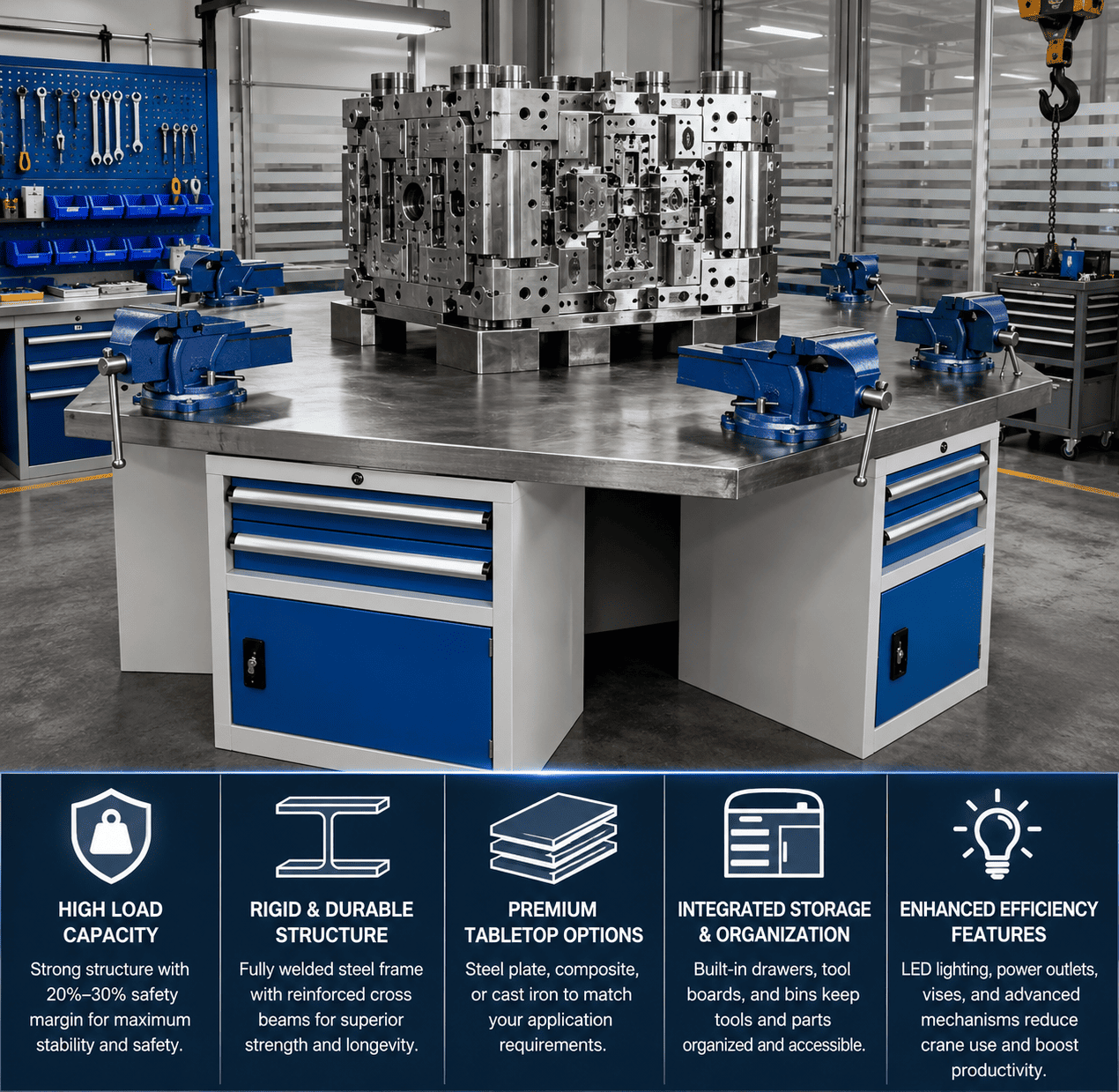
Calculate your total working weight by adding the mold, fixtures, and tools. This total should never exceed 70%–80% of the table's rated capacity3. This practice provides a crucial 20%–30% safety margin to ensure long-term structural integrity and handle unexpected dynamic loads.
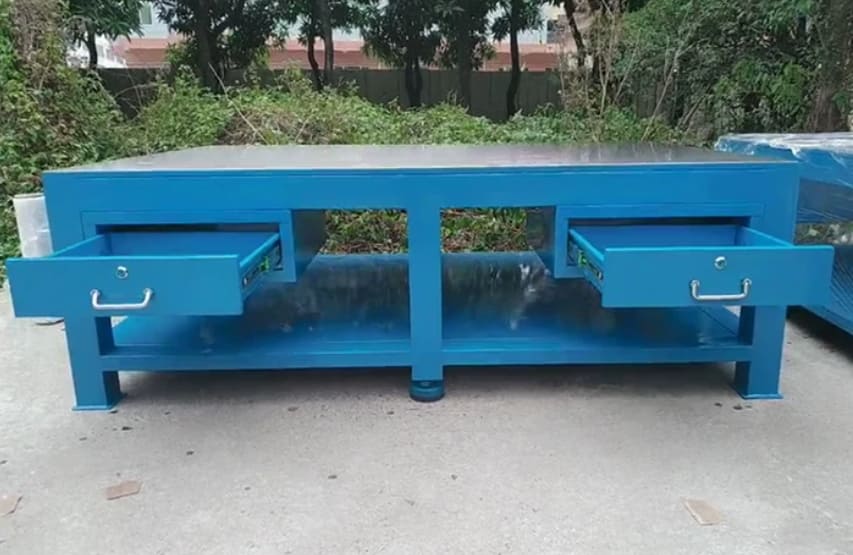
In my experience, the number one mistake people make is buying a table with a rated capacity that just matches their heaviest mold. This leaves no room for error. The working load isn't static; it includes the weight of the mold plus all the fixtures, heavy tools, and spare parts you place on it during maintenance. Sometimes, a technician might even need to apply force or use a hammer, which creates dynamic loads that stress the structure far more than a simple static weight4.
For this reason, I always recommend a safety margin. A table rated for 3 tons should not be used for a total working weight of 3 tons. Instead, cap your working load at around 2.1 to 2.4 tons. This 20%–30% buffer accounts for uneven weight distribution, the shock from hammering or assembly, and the natural fatigue of materials over years of use5. It’s a simple rule that ensures the table remains stable and safe for its entire service life.
| Factor | Description | Recommendation |
|---|---|---|
| Rated Capacity | The manufacturer's stated maximum static load. | Select a table with a rating well above your needs. |
| Working Weight | Mold + Fixtures + Tools + Parts. | This should be your primary calculation. |
| Safety Margin | The buffer between working weight and rated capacity. | 20%–30% minimum. |
| Dynamic Loads | Forces from hammering, pressing, or movement. | The safety margin helps absorb these shocks. |
What Tabletop Material and Structure Are Best for Heavy Mold Repair and Assembly?
The wrong tabletop can scratch your precision mold, or worse, the entire structure could warp under pressure. Choosing a table based on looks is a critical error.
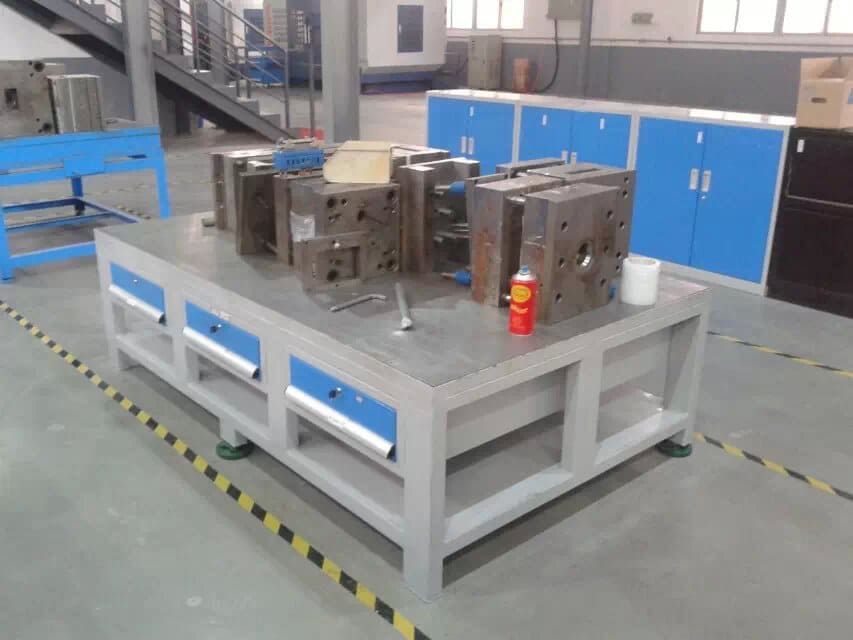
A heavy-duty mold table must have a fully welded rigid steel frame. For the tabletop, a thick steel plate is best for heavy assembly, while a composite material is ideal for precision electronic mold work due to its anti-static and shock-absorbing properties6.
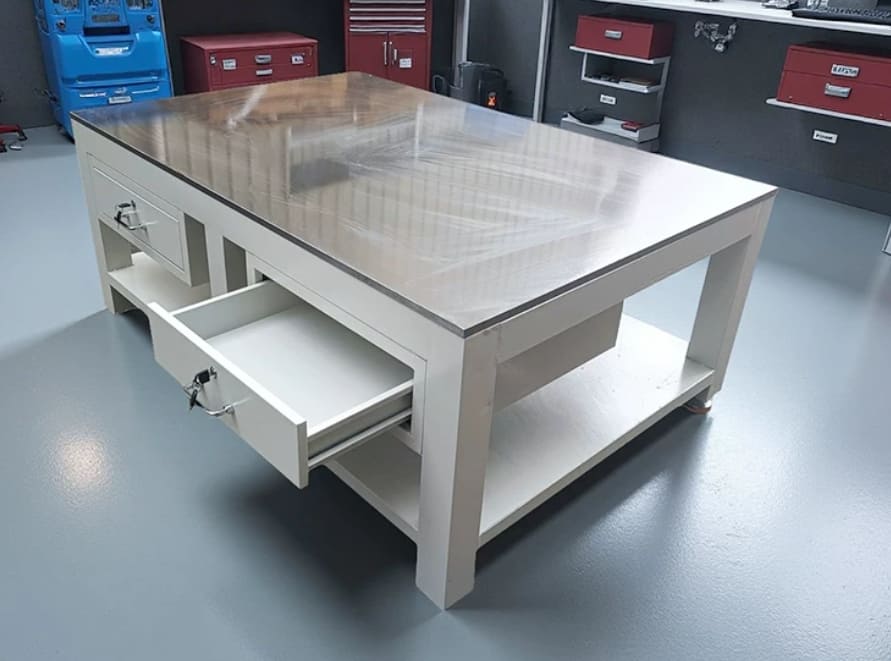
When you're dealing with molds that can weigh several tons, the table's structure is far more important than its appearance. I always look for a frame made from heavy-gauge square tubing or structural steel, with full welding construction. This creates a single, rigid unit that resists vibration and twisting. You should see reinforced cross beams underneath the tabletop for extra support. I strongly advise against bolt-assembled structures or tables with thin-walled legs. They are prone to loosening over time and simply cannot handle the stresses of heavy industrial use.
The tabletop material should match your work.
Tabletop Options for Different Needs
| Tabletop Material | Key Features | Best For |
|---|---|---|
| Heavy-Duty Steel Plate | 16mm+ thick solid steel7, extremely high load capacity (2-4 tons), heat and impact resistant. | Heavy mold assembly, repair, and general maintenance. The workhorse of most shops. |
| Composite Material | Anti-static, acid/alkali resistant, oil resistant, wear-resistant, and absorbs noise from hammering. | Precision electronic mold maintenance where static discharge is a concern. |
| Cast Iron / Ground Plate | Precision-ground flat surface (flatness ≤0.05 mm/m8), often with T-slots for clamping. | High-precision inspection, marking, and fitting work. |
The size of the tabletop also matters. Make sure it is at least 300–500 mm larger9 than the footprint of your largest mold. This gives your team the space they need to work safely and clamp fixtures without being cramped.
Which Features Improve Safety and Efficiency in Large Mold Maintenance Workstations?
A bare table creates a disorganized and inefficient workspace. Workers waste time searching for tools and parts, which increases downtime and the risk of accidents.
Integrated storage like drawers and hanging boards keeps tools organized and within reach. For enhanced efficiency, add features like LED lighting, power outlets, and advanced mechanisms like rotating platforms or sliding rails to minimize crane use and streamline the maintenance process.
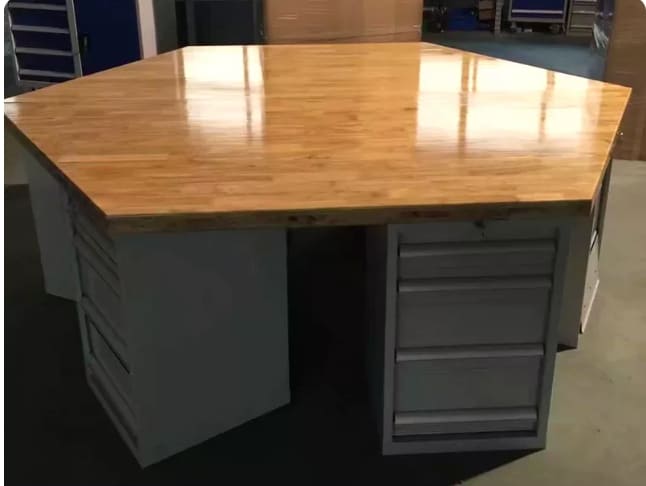
A great mold table is more than just a flat surface; it's a complete workstation. The right features can transform your workflow, making it safer and much more productive. When I help clients outfit their workshops, we focus on features that solve specific problems. Disorganization is a common one. Most high-quality mold workbenches solve this with integrated storage. This includes multiple drawers under the tabletop, each with a load capacity of around 50 kg10, perfect for heavy tools. Perforated hanging boards and parts bins keep smaller items visible and accessible.
For detailed maintenance work, good visibility is non-negotiable. That’s why auxiliary facilities like integrated LED lighting and power outlets are so valuable. They eliminate the need for clumsy extension cords and temporary work lights.
For high-end applications, we can go even further with advanced handling mechanisms. A table with a 360° rotating platform and positioning locks allows a technician to work on all sides of a mold without calling for a crane.11 Sliding rail systems can connect different work areas, allowing a single operator to safely move a mold from disassembly to maintenance. These features dramatically reduce reliance on overhead cranes, which is a major bottleneck and safety concern12 in many facilities.
Conclusion
Choosing the right mold table means balancing load capacity, structural integrity, tabletop material, and functional features. Following these principles ensures you get a safe, durable, and efficient workstation.
"Construction Incidents Investigation Engineering Reports - OSHA", http://www.osha.gov/construction/engineering. A report from a workplace safety agency, such as OSHA, could provide case studies or data on incidents involving the collapse of improperly selected or overloaded industrial workbenches and support stands, demonstrating the potential for equipment damage and personnel injury. Evidence role: case_reference; source type: government. Supports: The claim that improper support structures for heavy equipment can lead to catastrophic failure and safety hazards.. Scope note: The source may not specifically mention 'mold tables' but will cover the general principle of structural failure in industrial settings due to overloading. ↩
"[PDF] Experimental Analysis of Thread Movement in Bolted Connections ...", https://ntrs.nasa.gov/api/citations/19950008490/downloads/19950008490.pdf. An engineering design guide can explain that fully welded joints create a monolithic structure, which generally provides higher rigidity and resistance to racking forces compared to bolted assemblies. Bolted joints can be prone to slippage or loosening over time, especially when subjected to vibration and dynamic loads. Evidence role: mechanism; source type: education. Supports: The claim that welded structures offer greater rigidity compared to bolted ones.. Scope note: The source may also note that properly designed and torqued bolted connections can be very strong, but for maximum rigidity in a simple frame, welding is often preferred. ↩
"1926.403 - General requirements. | Occupational Safety and Health ...", http://www.osha.gov/laws-regs/regulations/standardnumber/1926/1926.403. Workplace safety guidelines and engineering principles often mandate a 'factor of safety' for structures supporting heavy loads. For example, OSHA regulations for materials handling equipment require design safety factors to account for variables like wear, fatigue, and dynamic loading, which aligns with the principle of not loading a table to its absolute maximum rated capacity. Evidence role: general_support; source type: government. Supports: The practice of using a safety margin by not loading a structure to its maximum rated capacity.. Scope note: A specific 20-30% value may not be explicitly stated, as safety factors can vary by application and regulation, but the source will support the underlying principle. ↩
"[PDF] Impact Loads - UNM", https://www.unm.edu/~bgreen/ME360/Impact%20Loads.pdf. An engineering or physics resource can explain that dynamic loads, which involve acceleration or impact (like hammering), generate forces that can be many times greater than the static weight of an object. This 'load amplification' is a critical consideration in structural design. Evidence role: mechanism; source type: education. Supports: The claim that dynamic forces create greater stress on a structure than an equivalent static weight.. ↩
"Fatigue (material) - Wikipedia", https://en.wikipedia.org/wiki/Fatigue_(material). A materials science resource can define material fatigue as the weakening of a material caused by repeated applied loads. It is the progressive and localized structural damage that occurs when a material is subjected to cyclic loading, which can eventually lead to failure even if the stress levels are below the ultimate tensile strength. Evidence role: definition; source type: encyclopedia. Supports: The concept that materials can weaken and fail over time due to repeated stress cycles.. ↩
"[PDF] Phenolic Resin Panels in Laboratories - Office of Research Facilities", https://orf.od.nih.gov/TechnicalResources/Documents/News%20to%20Use%20PDF%20Files/2015%20NTU/Phenolic%20Resin%20Panels%20in%20Laboratories%20-%20February%202015%20News%20to%20Use_508.pdf. Standards from organizations like the ESD Association (e.g., ANSI/ESD S20.20) specify the required electrical properties for work surfaces used in handling sensitive electronic components. Materials like phenolic composites are often used to meet these standards, providing controlled static dissipation to protect electronics from damage. Evidence role: general_support; source type: institution. Supports: The properties of materials used for anti-static workstations.. ↩
"Steel Plate Calculator | SkyCiv Engineering", https://skyciv.com/quick-calculators/steel-plate-calculator/. Engineering handbooks and structural steel guides provide formulas and tables to calculate the load-bearing capacity and deflection of a steel plate based on its thickness, material properties, and support conditions. These calculations demonstrate that for multi-ton loads, a significant thickness is required to maintain flatness and prevent yielding. Evidence role: general_support; source type: education. Supports: The relationship between steel plate thickness and its ability to support heavy loads without excessive deflection.. Scope note: The source will provide the calculation method rather than confirming the exact '16mm+' figure, as the required thickness depends on the table's dimensions and support structure. ↩
"Comparison of Calibration Methods for a Surface Plate", https://www.osti.gov/servlets/purl/1145574. International and national standards, such as ASME B89.3.7 or ISO 8512, define the flatness tolerances for different grades of metrology surface plates. For example, a Grade B or Grade 2 inspection plate typically has a flatness tolerance in the range of 0.01-0.05 mm over a given area, confirming that such precision is a standard industry specification. Evidence role: definition; source type: institution. Supports: The standard flatness tolerances for precision surface plates.. ↩
"1926.403 - General requirements. | Occupational Safety and Health ...", http://www.osha.gov/laws-regs/regulations/standardnumber/1926/1926.403. Ergonomics and workplace safety guidelines, such as those from NIOSH or OSHA, emphasize the importance of providing sufficient space for workers to perform tasks without awkward postures or risk of injury. This includes having adequate clearance around a workpiece for tool use, movement, and placement of components. Evidence role: general_support; source type: government. Supports: The need for adequate clearance around a workpiece for safe and efficient work.. Scope note: The source will support the principle of providing clearance rather than validating the specific '300-500 mm' dimension, which is application-dependent. ↩
"[PDF] Building Standards - Capital Project Management", https://cpm.umn.edu/sites/cpm.umn.edu/files/2024-04/division12_50_00%20FURNITURE%202024%20Update.pdf. Product testing standards from organizations like the Business and Institutional Furniture Manufacturers Association (BIFMA) or the Scientific Equipment and Furniture Association (SEFA) set durability and load capacity requirements for storage units. These standards often include tests for drawers with loads ranging from 34 kg (75 lbs) to over 68 kg (150 lbs) for heavy-duty applications. Evidence role: statistic; source type: institution. Supports: The typical load capacity for drawers in heavy-duty industrial furniture.. Scope note: The source provides a range of typical industry standards rather than confirming a single '50 kg' value for all products. ↩
"Minimizing quay crane downtime in container terminals using ... - PMC", https://pmc.ncbi.nlm.nih.gov/articles/PMC12749770/. Research in ergonomics and lean manufacturing highlights the benefits of using work positioners, such as rotating platforms or lifts, to bring the work to the worker. These systems are shown to reduce musculoskeletal strain, improve safety by minimizing manual or crane-assisted repositioning, and increase productivity by reducing wait times for material handling equipment. Evidence role: case_reference; source type: research. Supports: The use of integrated handling mechanisms to improve ergonomics and efficiency in maintenance tasks.. ↩
"Accident Search Results | Occupational Safety and Health ... - OSHA", https://www.osha.gov/ords/imis/AccidentSearch.search?acc_keyword=%22Overhead%20Crane%22&keyword_list=on. Reports from workplace safety agencies like the Occupational Safety and Health Administration (OSHA) document fatalities and serious injuries related to crane operations, including incidents involving falling loads, contact with power lines, and crushing hazards. This data supports the characterization of crane use as a significant safety concern in industrial environments. Evidence role: statistic; source type: government. Supports: The claim that overhead crane use is associated with significant safety risks.. ↩