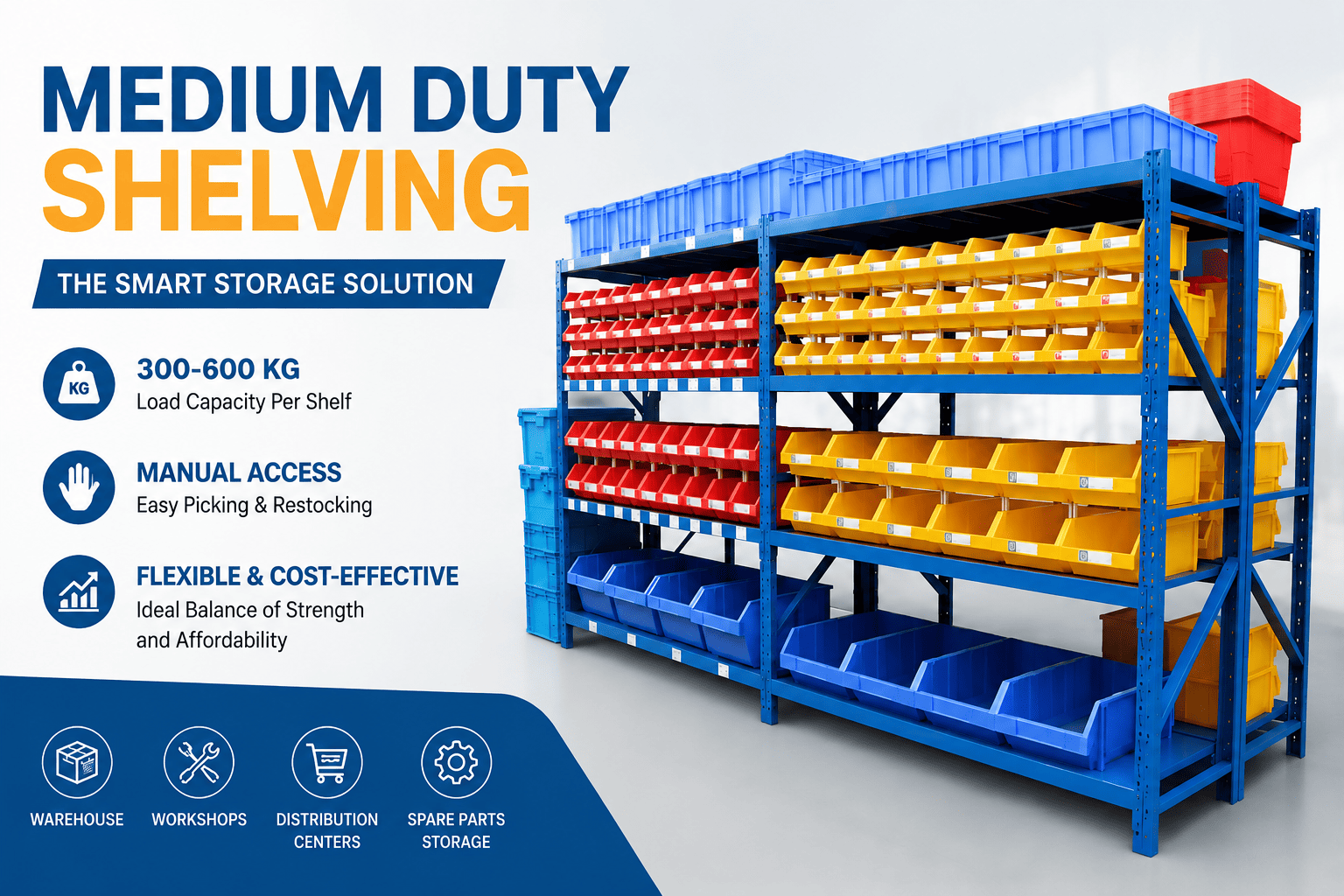
Your storage area is a mess, but heavy-duty pallet racks feel like overkill. Light-duty shelves just can't handle the weight. Medium duty shelving is the perfect solution for this gap.
Medium duty shelving is a versatile storage system built for items too heavy for standard shelving but not requiring a forklift1. It's the ideal, cost-effective choice for manual picking operations2, offering a perfect balance between the load capacity of heavy-duty racks and the accessibility of light-duty shelves3.
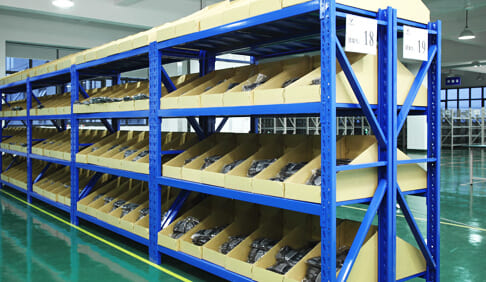
You might be thinking this sounds good, but you're not sure if it's the right fit for your specific needs. It's a common question we get from our clients who are in a growth phase. They need something better, but a full-scale heavy-duty system isn't practical or affordable yet. Let’s explore what medium duty shelving is and how it solves some of the most common storage headaches we see in the industry. This will help you decide if it's the smart investment your business needs right now.
What Is Medium Duty Shelving and Why It Is the Ideal Balance Between Light and Heavy Storage Systems?
Choosing a storage system can be tough. Light-duty shelves feel weak, while heavy-duty racks seem too expensive for your needs. Medium duty shelving gives you the strength you need without overspending.
It is a storage system designed for hand-loaded items, typically holding between 150 to 600 kg per shelf level4. This system bridges the gap perfectly, providing more durability than light-duty shelving and better flexibility for manual access than heavy-duty pallet racks. It's the ultimate middle ground.
For years, I've seen companies struggle with this choice. They either risk safety with overloaded light shelves or waste money on a heavy-duty system they don't fully use. Medium duty shelving hits that sweet spot. It's built from stronger steel than light-duty options5 but is designed for people, not forklifts. This makes it perfect for operations where employees need to frequently pick and restock items by hand.
Finding the Right Balance
The key is understanding your inventory. Heavy-duty pallet racking is for palletized goods weighing thousands of kilograms6. Light-duty shelving is for office supplies or very light products. Medium duty is for everything in between.
| Feature | Light Duty Shelving | Medium Duty Shelving | Heavy Duty Racking |
|---|---|---|---|
| Typical Load | Under 150 kg/shelf | 150 - 600 kg/shelf | 1000+ kg/level |
| Best For | Office files, small parts | Boxes, spare parts, tools | Palletized inventory |
| Access Method | Manual | Manual | Forklift7 |
| Cost | Low | Moderate | High |
Flexibility for Growth
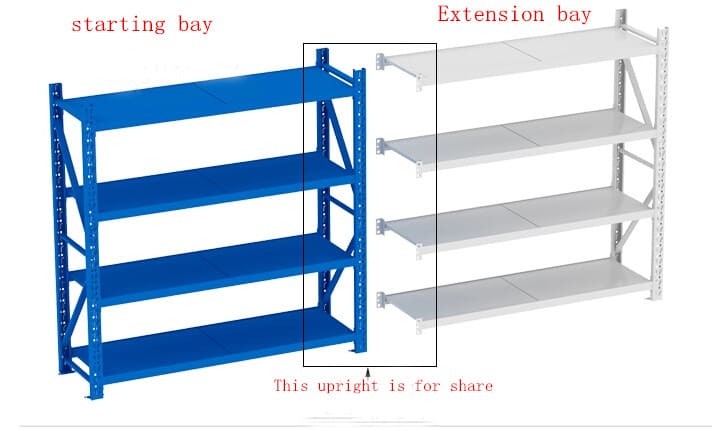
Most systems, like our boltless models, are incredibly easy to assemble and adjust. You can change shelf heights without any special tools8. This flexibility is perfect for growing businesses, like an e-commerce company, where product sizes and storage needs change all the time. You get a robust, professional storage solution without the rigidity and cost of a full pallet rack installation.
Common Storage Problems Medium Duty Shelving Solves in Warehouses, Workshops, and Distribution Centers?
Your floor space is cluttered with boxes, parts, and equipment. This mess slows down your team and creates safety risks9. Medium duty shelving brings order to this chaos quickly and safely.
It solves the problem of storing mixed, non-palletized inventory that is too heavy for basic shelving. It’s perfect for organizing messy floor space in workshops, parts storerooms, and e-commerce centers, which improves workflow and safety10 without the high cost of heavy-duty systems.
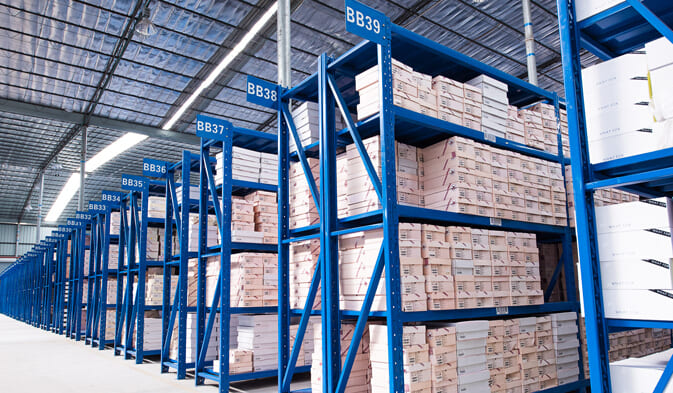
I once visited a client who ran an auto repair shop. Their spare parts were stacked in dangerous piles on the floor. It was a safety nightmare, and finding anything took forever. We installed a few bays of medium duty shelving, and it completely transformed their operation. It solves two very common problems we see every day.
The "Too Heavy for Light-Duty" Problem
Many businesses store items that aren't huge but are dense and heavy. Think of spare motors, automotive parts, hardware, or bulk supplies in boxes. Standard consumer-grade or light-duty office shelving will bend or even collapse under this weight11. This is not only a loss of product but a serious safety hazard for your employees. Medium duty shelving is engineered specifically for these loads, providing a stable and secure home for those "in-between" items.
The "Not Ready for Pallet Racking" Problem
Your storage is messy, but you don't store things on pallets. This is a classic sign that you need medium duty shelving. Many workshops, e-commerce fulfillment centers, and parts departments face this issue. The space is disorganized, but investing in a full pallet racking system is not cost-effective. Medium duty shelving allows you to go vertical, clearing your floor12 and organizing your inventory for easy manual access without the massive footprint and expense of a heavy-duty system.
How to Choose the Right Medium Duty Shelving for Improving Space Utilization and Picking Efficiency?
You know you need medium duty shelving, but you are not sure what to look for. Choosing the wrong size or capacity can waste your money and your space. Following a simple checklist ensures you get the perfect fit.
To choose the right shelving, first measure the weight and size of your typical inventory. Next, measure your available floor space and ceiling height. Finally, think about how often you access items to choose a system, like a boltless design, that helps your team work faster.
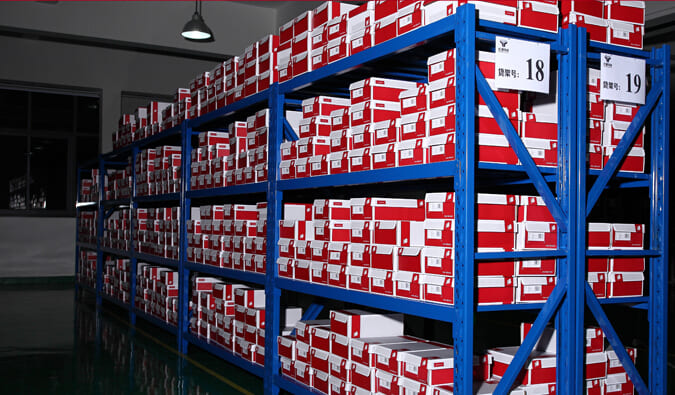
Getting this right from the start saves so much time and money. A well-chosen system should feel like it was custom-made for your space and your products. It makes work flow smoothly and keeps everyone safe. We always walk our customers through a few simple steps to make sure they get exactly what they need.
Step 1: Analyze Your Inventory
Before you do anything else, look at what you need to store. What is the heaviest box or item that will go on a single shelf? Always plan for your heaviest item, not the average. Then, measure the dimensions (length, width, height) of your most common boxes or products. This will help you select the right shelf depth and width, ensuring there is no wasted space.
Step 2: Measure Your Space
Get out a tape measure. How much floor area can you dedicate to shelving? More importantly, what is your clear ceiling height? You want to use as much vertical space as possible, but make sure the top shelf is still safely accessible by your team, perhaps with a rolling ladder. Don’t forget to account for aisle width.
Step 3: Consider Your Workflow
How will your team use these shelves?
- Assembly: Boltless systems are great for fast setup and easy shelf adjustments, which is ideal if your inventory changes often. Bolted systems offer a bit more rigidity for more permanent setups.
- Decking: What will the items sit on? We offer steel panels for heavy point loads, wire mesh for better airflow and visibility, or particle board for a simple, flat surface.
Choosing correctly based on these factors directly impacts how efficiently your team can find, pick, and restock items.
Conclusion
Medium duty shelving is a smart and versatile storage solution. It offers the perfect balance of strength, easy access, and cost-effectiveness for warehouses, workshops, and growing businesses with non-palletized goods.
"[PDF] Automated or Manual Storage Systems - ScholarWorks", https://scholarworks.calstate.edu/downloads/6395wc79z. A neutral warehousing or material-handling reference should distinguish hand-loaded shelving from pallet-rack systems by typical access method and load range, supporting the claim that medium-duty shelving occupies an intermediate category between light shelving and forklift-served pallet storage. Evidence role: definition; source type: institution. Supports: Medium duty shelving is intended for goods heavier than standard shelving can safely hold, while remaining suitable for manual rather than forklift handling.. Scope note: Terminology and load classes vary by manufacturer and jurisdiction, so the source may support the category distinction more directly than the exact phrase. ↩
"Small Parts Order Picking: Design and Operation", https://www2.isye.gatech.edu/~mgoetsch/cali/Logistics%20Tutorial/order/article.htm. A warehousing or logistics source should explain that order-picking systems for small cartons, parts, and piece goods commonly rely on manual access shelving, supporting the use of shelving systems in manual picking environments. Evidence role: general_support; source type: education. Supports: Medium duty shelving is appropriate for manual picking operations where workers retrieve goods by hand.. Scope note: Such sources may discuss manual picking broadly rather than medium-duty shelving specifically. ↩
"Pallet Racking (selective system) - Interlake Mecalux", https://www.interlakemecalux.com/warehouse-racking/pallet-racking. A material-handling reference comparing shelving and pallet-rack systems should show that shelving is generally designed for hand access while pallet racks provide higher load capacity for palletized goods, giving contextual support to the asserted trade-off between capacity and accessibility. Evidence role: general_support; source type: institution. Supports: Medium duty shelving sits between light-duty shelving and heavy-duty pallet racking in capacity and accessibility.. Scope note: The phrase “perfect balance” is evaluative; evidence can support the underlying comparison but not the subjective wording. ↩
"What Is a Medium Duty Storage Rack and How Much Weight Can It ...", https://top-notchrack.com/what-is-a-medium-duty-storage-rack-and-how-much-weight-can-it-hold/. An engineering, standards, or material-handling source should document commonly stated working-load ranges for medium-duty shelving, supporting the article’s stated 150–600 kg per shelf-level range. Evidence role: statistic; source type: other. Supports: Medium duty shelving typically supports about 150 to 600 kg per shelf level.. Scope note: There may be no universal industry standard for the term “medium duty”; load ratings depend on shelf span, decking, steel gauge, and manufacturer testing. ↩
"Closed Metal Shelving - Grainger Industrial Supply", https://www.grainger.com/category/material-handling/storage-workspace/shelving-storage-racks/freestanding-shelving-shelf-racks/freestanding-metal-shelving-shelf-racks/standard-metal-shelving-components/closed-metal-shelving. A technical source on industrial shelving construction should explain that higher-duty shelving generally uses heavier-gauge steel components or stronger beam/upright designs than light-duty shelving, supporting the structural comparison. Evidence role: mechanism; source type: research. Supports: Medium-duty shelving is structurally stronger than light-duty shelving because it uses more robust steel components.. Scope note: The support is likely to be general unless the article identifies a specific product line or steel specification. ↩
"Pallet - Wikipedia", https://en.wikipedia.org/wiki/Pallet. A pallet-racking reference should state that pallet racks are storage-aid systems for palletized materials and commonly support high unit loads, providing context for the claim that heavy-duty racks serve palletized goods at much higher weights than shelving. Evidence role: definition; source type: encyclopedia. Supports: Heavy-duty pallet racking is used for palletized inventory and can be designed for very high loads.. Scope note: The exact phrase “thousands of kilograms” should be verified against a source that reports load ranges, because capacities vary by rack design and local standards. ↩
"[PPT] Module 1 The Warehousing Industry - OSHA", https://www.osha.gov/sites/default/files/2018-12/fy14_sh-26328-sh4_Mod1Warehousing_0.pptx. A material-handling or safety reference should note that pallet racks are commonly loaded and unloaded with lift trucks, supporting the table’s association between heavy-duty racking and forklift access. Evidence role: general_support; source type: government. Supports: Heavy-duty pallet racking is commonly accessed by forklifts or similar lift trucks.. Scope note: Some pallet-rack systems can also be accessed by other equipment, so the evidence should support common practice rather than exclusivity. ↩
"REIBII 2500lbs Boltless Shelving, Adjustable Laminated Shelving ...", https://reibii.com/products/adjustable-heavy-duty-shelving-load-2500lbs?srsltid=AfmBOorH5IsRiR44QMRz4NllF_8ARVDeQ22ELG40gvhJbJ7-79gxuVnK. A technical description of boltless shelving should explain that interlocking beams and uprights allow shelf levels to be assembled or repositioned without bolts, supporting the claim that shelf heights can be adjusted without special tools. Evidence role: mechanism; source type: institution. Supports: Boltless shelving designs commonly allow shelf height adjustment without special tools.. Scope note: Tool-free adjustment may depend on the specific boltless design and whether safety clips, decking, or anchors must be removed. ↩
"1910.176 - Handling materials - general. | Occupational Safety and ...", http://www.osha.gov/laws-regs/regulations/standardnumber/1910/1910.176. An occupational-safety source on housekeeping should state that cluttered floors, obstructed aisles, and improperly stored materials increase risks such as trips, falls, struck-by incidents, or blocked access, supporting the safety concern raised in the article. Evidence role: expert_consensus; source type: government. Supports: Cluttered storage areas in warehouses or workshops can create workplace safety hazards.. Scope note: The source will support the general safety risk of cluttered storage areas, not the effectiveness of a particular shelving product. ↩
"1926.250 - General requirements for storage. - OSHA", http://www.osha.gov/laws-regs/regulations/standardnumber/1926/1926.250. A warehouse-operations or occupational-safety source should show that orderly storage, clear aisles, and organized inventory improve access and reduce handling or housekeeping hazards, providing contextual support for the claim that shelving can improve workflow and safety. Evidence role: general_support; source type: government. Supports: Organizing non-palletized inventory on shelving can improve workflow and workplace safety.. Scope note: The evidence may demonstrate general benefits of organized storage rather than measuring medium-duty shelving installations specifically. ↩
"1926.250 - General requirements for storage. - OSHA", http://www.osha.gov/laws-regs/regulations/standardnumber/1926/1926.250. A safety or engineering source on shelving load ratings should explain that exceeding rated loads can deform shelving components or cause collapse, supporting the warning about overloaded light-duty shelves. Evidence role: mechanism; source type: government. Supports: Shelving that is loaded beyond its rated capacity may deform or collapse.. Scope note: The source should be used to support the general hazard of overloading; actual failure depends on shelf design, load distribution, anchoring, and condition. ↩
"A Complete Guide to Warehouse Vertical Storage Systems - Kardex", https://www.kardex.com/en-us/blog/vertical-storage-systems. A warehouse-design or logistics source should explain that vertical storage systems increase cubic-space utilization and reduce floor-space demands, supporting the claim that shelving can clear floor areas by using height. Evidence role: mechanism; source type: education. Supports: Installing shelving can improve space utilization by using vertical space and reducing items stored on the floor.. Scope note: The source can support the space-utilization principle, but the amount of floor space recovered depends on layout, aisle width, shelf dimensions, and inventory profile. ↩