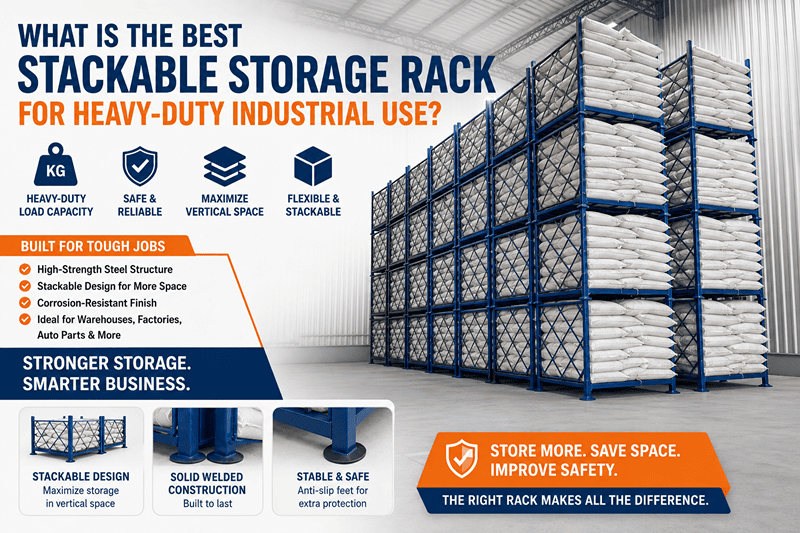
What Is the Best Stackable Storage Rack for Heavy-Duty Industrial Use? Wasting warehouse space with unsafe stacking1? This inefficiency costs you money and risks collapse. The right heavy-duty stackable storage rack solves this problem by maximizing vertical space and improving safety2.
The best heavy-duty stackable storage rack depends entirely on your specific needs. For storing heavy products like molds or auto parts long-term, a fixed, welded heavy-duty rack is best.3 For seasonal inventory or flexible layouts, a foldable stack rack is the superior choice to save space.4
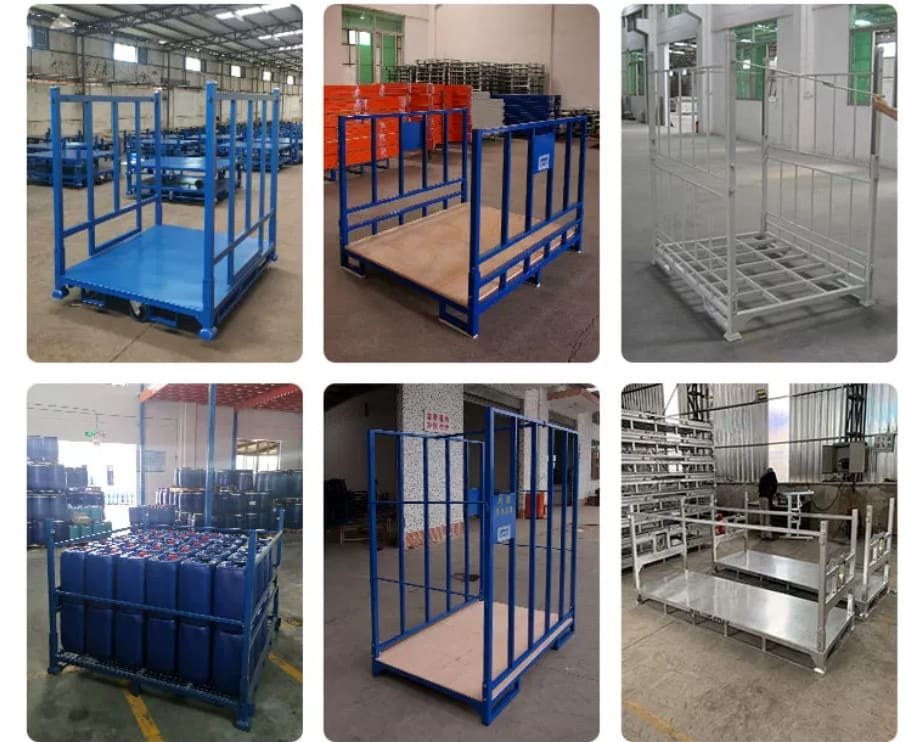
Choosing the perfect stack rack isn't about finding the single "best" one on the market. It's about finding the one that is best for your factory or warehouse. Over my years in this business, I've seen companies make costly mistakes by picking a rack that didn't match their daily work. To help you avoid that, I've broken down the selection process into a few simple questions. Answering them will lead you to the right choice, saving you time, money, and a lot of headaches down the road. Let's get started.
How to Choose the Right Heavy-Duty Stackable Storage Rack for Different Industrial Applications?
Buying a rack that doesn't fit your workflow is a huge waste. It can cause production bottlenecks or even create safety hazards.5 The solution is simple: match the rack to the job.
First, you need to understand your real working environment. For frequent material turnover between workstations, choose movable racks. For dense storage of finished goods, pick fixed heavy-duty racks. For cold storage, you must prioritize anti-rust galvanized or powder-coated models to ensure durability.
When I visit a client's facility, the first thing I do is watch how their materials move. The application tells you everything you need to know about the right type of rack. You wouldn't use the same tool for every job, and the same logic applies here. Let's look at a few common scenarios I see all the time.
For High-Turnover and Production Lines
In places like automotive assembly lines or workshops where parts are constantly moving, efficiency is everything. This is where movable stack racks with casters are a game-changer. They act as mobile storage units, bringing materials right to the workstation. This cuts down on forklift trips and keeps the production flow smooth.6 However, remember that their stacking height is limited for safety7.
For Dense Storage and Heavy Loads
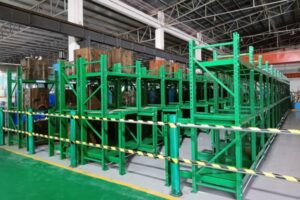
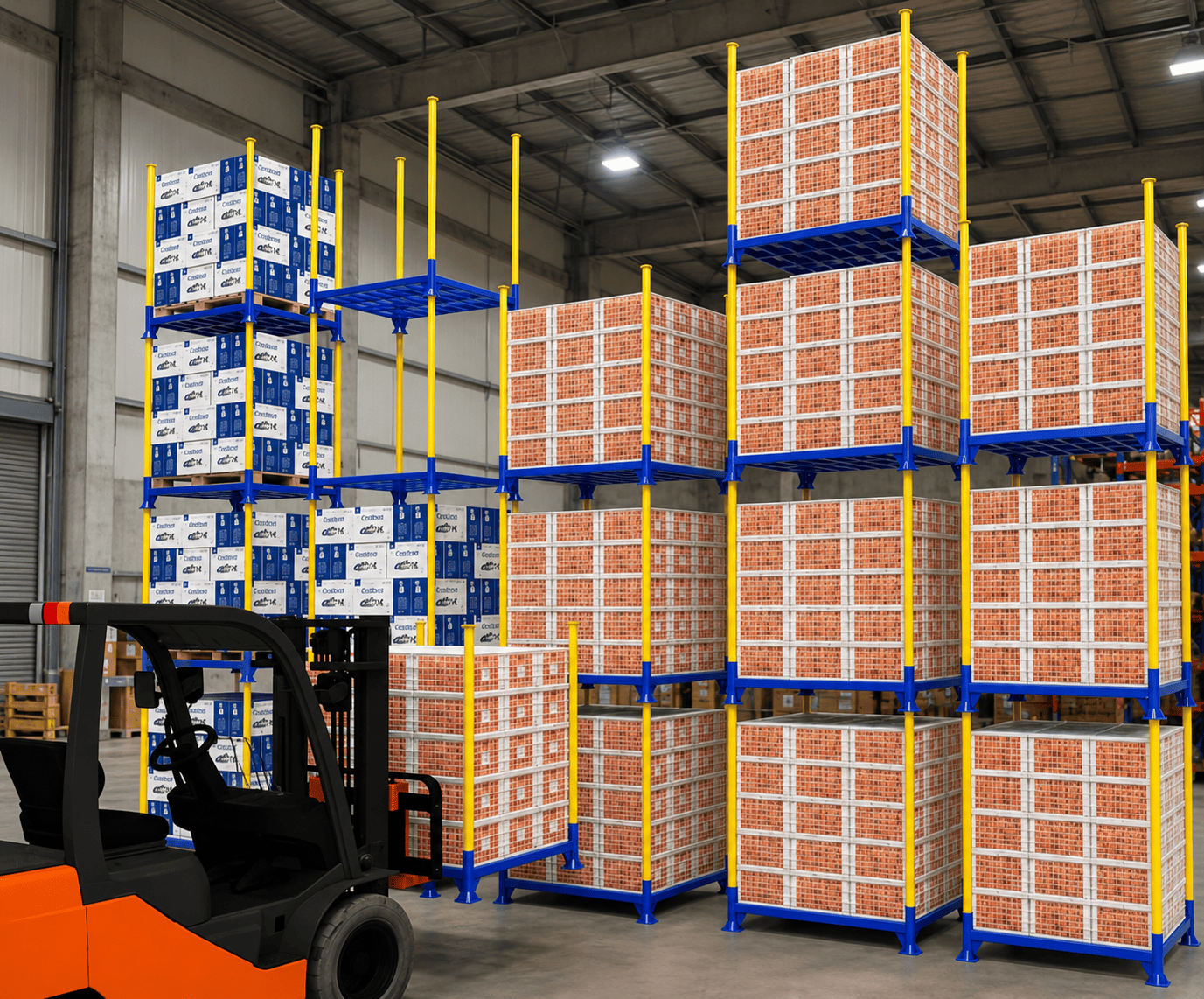
If you need to store heavy raw materials, castings, or finished goods in bulk, your priority is strength and stability. Fixed heavy-duty stack racks are perfect for this. Their welded structure offers excellent load capacity and allows you to stack them several levels high, making the most of your warehouse's vertical space. They are the workhorses for dense storage zones.
For Specialized Environments
Factories in the food industry or warehouses with cold storage have unique challenges. Moisture and temperature changes can cause rust and corrosion.8 In these cases, the rack's surface treatment is critical. I always recommend a galvanized or high-quality powder-coated finish9 to protect the steel and extend the rack's life.
| Application Scenario | Recommended Rack Type | Key Benefit |
|---|---|---|
| Frequent material turnover | Movable Stack Rack | Mobility and flexibility |
| Dense, long-term storage | Fixed Heavy-Duty Stack Rack | High load capacity and stability |
| Limited space, seasonal use | Foldable Stack Rack | Saves floor space when idle |
| Cold storage or humid areas | Galvanized/Powder-Coated Rack | Corrosion and rust resistance |
What Load Capacity and Structural Features Matter Most in Heavy-Duty Stackable Storage Racks?
A cheap rack seems like a good deal at first. But I've seen them bend and even collapse under load, risking worker safety and damaging valuable products. You must focus on structure.
Load capacity is the most critical factor. For heavy industrial use, you need a rack rated for 1 to 3 tons.10 Look for structures made from high-strength Q235B steel11 with strong, continuous welds instead of bolts, reinforced bases, and a durable powder-coated or galvanized finish.
When we design our racks, we don't just think about holding weight; we think about holding it safely for years. The details of the design and materials are what separate a reliable rack from a liability. A rack's strength comes from more than just thick steel. It's about smart engineering.
Understanding Load Capacity
First, you need to know the weight of what you're storing. Racks are generally categorized by their capacity per level:
- Light-duty (300–500 kg): Good for small parts, empty boxes, or lightweight goods.
- Medium-duty (500–1000 kg): Suitable for most general factory materials and e-commerce products.
- Heavy-duty (1000–3000 kg): Essential for heavy items like hardware castings, auto parts, molds, and steel coils.
Always choose a capacity that safely exceeds your heaviest load. Never push the limits.
Key Structural Features to Look For
The material and build quality determine a rack's lifespan. I always tell my clients to inspect these features closely.
- Material: We use Q235B steel for our main structures because it offers the right balance of strength and toughness to resist deformation.
- Welding: Look for clean, solid welds. We prefer welding over bolts for key structural joints, like in our DDH-001 model. Welds don't loosen over time, ensuring long-term reliability.12
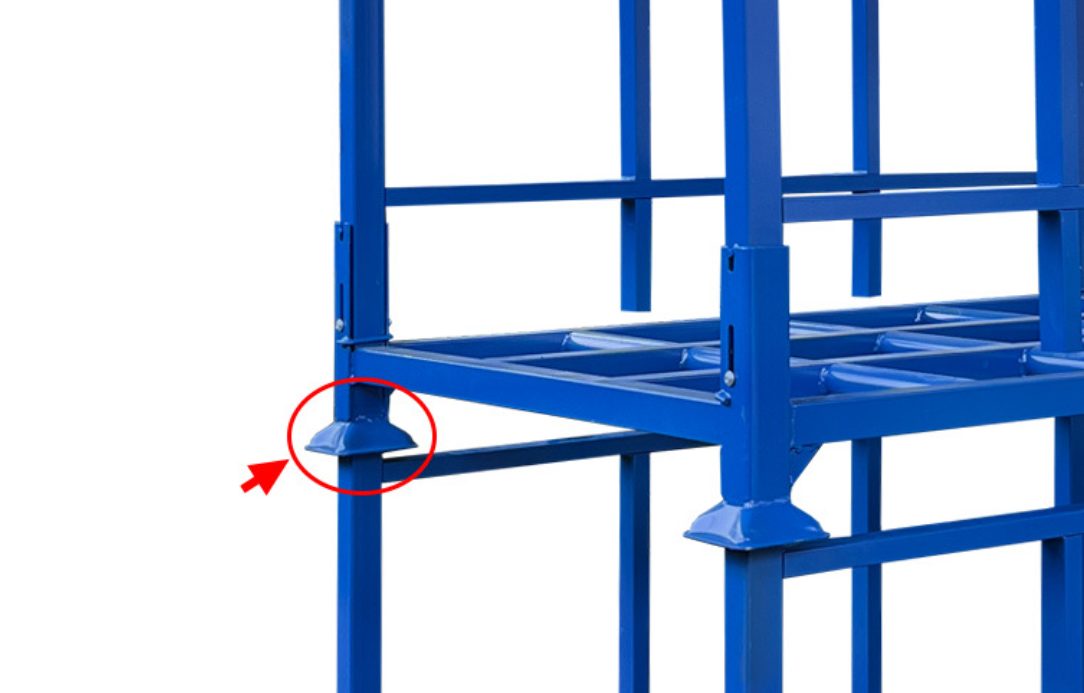
- Reinforcements: A stable base is crucial. Look for reinforcing ribs, corner braces, and a solid frame at the bottom. Our designs often use a four-post structure with transverse beams to create a stable base that distributes pressure evenly.
- Surface Treatment: A good finish protects your investment. Powder coating provides a durable, corrosion-resistant layer that stands up to the tough environment of a factory floor or a humid cold storage facility.
Why Are Foldable and Heavy-Duty Stackable Storage Racks Becoming Popular in Modern Warehouses?
Have you ever seen a warehouse where empty racks take up valuable floor space? This wasted area costs money and kills flexibility. Foldable stack racks were designed to solve exactly this problem.
Foldable stack racks are popular because they save a huge amount of space. When they are not needed, you can simply fold the posts down, making the rack flat for compact storage. This is perfect for businesses with seasonal inventory or constantly changing warehouse layouts.
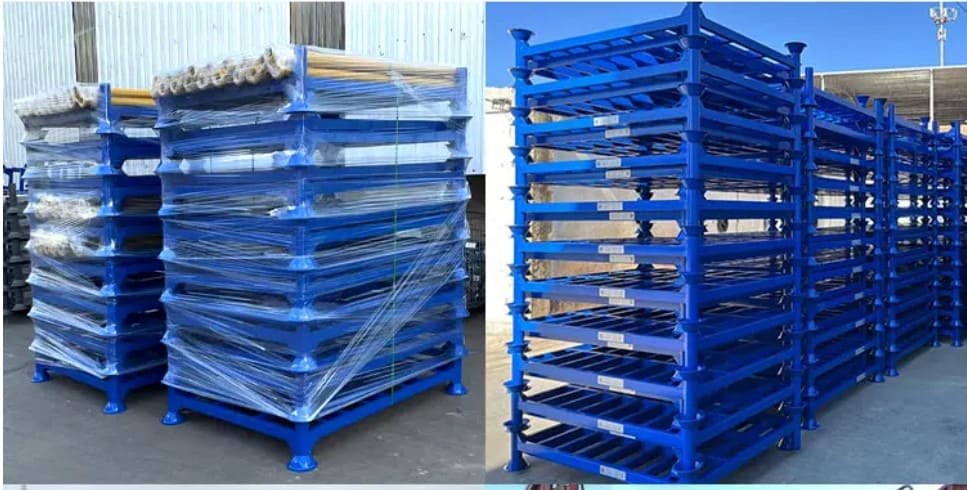
I remember working with an e-commerce client whose inventory needs would triple during the holiday season. In the off-season, their warehouse was a graveyard of empty, fixed racks. It was a huge waste of space. We switched them to foldable stack racks, and it completely transformed their operation. They could now store all the empty racks in a small corner, freeing up the entire floor for other tasks. This flexibility is why these racks are becoming a standard in modern logistics.
The Space-Saving Advantage
The primary benefit is obvious: when folded, these racks occupy a fraction of their assembled footprint. You can stack a dozen empty folded racks in the same space that two or three assembled racks would take up. For any business with fluctuating inventory—like seasonal goods, project-based manufacturing, or 3PL services—this is a massive advantage. It means you only use your floor space for storage when you actually need it.
Flexibility Over Fixed Racking
Traditional pallet racking is bolted to the floor. It's expensive to install and even more expensive to reconfigure. Stack racks are different. They are a modular, flexible system. You can rearrange your entire warehouse layout in an afternoon without any special tools or contractors. This allows you to adapt quickly to new products or workflows. You can create dense storage blocks for one product today and an open staging area for another product tomorrow. This level of agility is impossible to achieve with fixed systems. It gives you control over your space that was previously unimaginable.
Conclusion
Choosing the right heavy-duty stack rack comes down to your application, load, and need for flexibility. Get these right to boost safety, improve efficiency, and reclaim valuable warehouse space.
"1926.250 - General requirements for storage. - OSHA", http://www.osha.gov/laws-regs/regulations/standardnumber/1926/1926.250. Occupational safety guidance describes improperly stacked or unstable stored materials as fall/collapse hazards in warehouses, supporting the safety premise behind avoiding unsafe stacking; it does not quantify the article’s stated financial impact. Evidence role: expert_consensus; source type: government. Supports: Unsafe stacking in warehouses can create collapse risks and safety hazards.. Scope note: Supports the safety hazard generally, not the specific cost impact for any one warehouse. ↩
"1926.250 - General requirements for storage. - OSHA", http://www.osha.gov/laws-regs/regulations/standardnumber/1926/1926.250. Warehouse safety and storage-system guidance explains that engineered racking systems are used to store loads vertically while controlling instability and collapse risks, supporting the general claim; it does not prove that every stackable rack improves safety in all applications. Evidence role: general_support; source type: government. Supports: Appropriate heavy-duty stackable storage racks can improve use of vertical space and support safer storage practices.. Scope note: Contextual support only; rack safety depends on correct design, load rating, installation, and use. ↩
"[PDF] Specification for the Design, Testing, and Utilization of Industrial ...", https://scholarsmine.mst.edu/cgi/viewcontent.cgi?referer=&httpsredir=1&article=1000&context=ccfss-rmi. Engineering and warehousing references describe welded steel rack frames as rigid load-bearing structures suitable for heavy static storage, supporting the rationale for fixed welded racks in long-term heavy-load applications; the source would not determine that this is the best option for every facility. Evidence role: mechanism; source type: education. Supports: Fixed welded heavy-duty racks are well suited to long-term storage of heavy industrial items such as molds or auto parts.. Scope note: Supports the structural rationale, not a universal best-product ranking. ↩
"Pallet Rack Layout Optimization for Seasonal Inventory Changes", https://palletrackworld.com/how-to-optimize-pallet-rack-layouts-for-seasonal-inventory-changes/?srsltid=AfmBOop9hJZLOkJDZn77W27pQ3y12Hhz3oYMZ3C3_U9GWdKJ8IoavWmV. Materials-handling references describe collapsible or foldable racks as returnable/temporary storage equipment that reduces empty-storage volume, supporting their use where inventory levels fluctuate; this does not establish superiority over all alternatives. Evidence role: general_support; source type: research. Supports: Foldable stack racks are useful for seasonal inventory and flexible warehouse layouts because they reduce storage volume when empty.. Scope note: Supports space-saving suitability, not a universal superiority claim. ↩
"Analysis of Material Handling Safety in Construction Sites and ...", https://pmc.ncbi.nlm.nih.gov/articles/PMC4584068/. Lean manufacturing and occupational safety literature links poor material-flow design and unsuitable storage/handling equipment with delays, excess handling, and workplace hazards, supporting the article’s warning in general terms; it does not assess any specific rack purchase. Evidence role: expert_consensus; source type: paper. Supports: Choosing storage racks that do not match workflow can contribute to production bottlenecks and safety hazards.. Scope note: General operational support rather than direct evidence about one rack type. ↩
"(PDF) The travelling of forklifts in warehouses - Academia.edu", https://www.academia.edu/75691478/The_travelling_of_forklifts_in_warehouses. Material-handling research shows that point-of-use storage and mobile handling systems can reduce transport distance and non-value-added movement, supporting the mechanism by which movable racks may reduce forklift trips; the effect size depends on layout and demand patterns. Evidence role: mechanism; source type: paper. Supports: Movable stack racks with casters can reduce forklift trips and improve production flow when used for point-of-use material delivery.. Scope note: Contextual support; the actual reduction in forklift trips requires site-specific measurement. ↩
"1926.250 - General requirements for storage. - OSHA", http://www.osha.gov/laws-regs/regulations/standardnumber/1926/1926.250. Industrial rack safety guidance emphasizes that stacking height must be limited by load stability, rated capacity, and manufacturer specifications, supporting the safety basis for limiting stacked mobile racks; it does not provide a single universal height limit. Evidence role: expert_consensus; source type: government. Supports: Movable stack racks have practical stacking-height limits for safety reasons.. Scope note: Supports the principle, but safe height varies by rack design, load, floor condition, and regulations. ↩
"Influence of Rust Layer on Corrosion-Critical Humidity in Outdoor ...", https://pmc.ncbi.nlm.nih.gov/articles/PMC12113476/. Corrosion science references identify moisture, oxygen, and environmental cycling as contributors to steel corrosion, supporting the claim that humid or temperature-varying storage environments can promote rust; it does not evaluate any particular warehouse. Evidence role: mechanism; source type: education. Supports: Moisture and temperature changes in environments such as cold storage can contribute to rust and corrosion of steel racks.. Scope note: General corrosion mechanism; actual corrosion rate depends on contaminants, coatings, and exposure duration. ↩
"Hot-dip galvanization - Wikipedia", https://en.wikipedia.org/wiki/Hot-dip_galvanization. Materials engineering sources describe galvanizing and powder coatings as protective barrier systems that reduce corrosion of steel, supporting their use for racks in humid or cold-storage environments; durability still depends on coating quality and damage during use. Evidence role: mechanism; source type: research. Supports: Galvanized or powder-coated finishes can protect steel racks from corrosion and extend service life in humid environments.. Scope note: Supports corrosion protection generally, not the lifespan of a specific rack finish. ↩
"Capacity Chart - Warehouse Racking", https://www.warehouserack.com/capacity-chart-ezp-44.html?chapter=200. Industrial storage-rack standards and load-rating guidance require racks to be designed, labeled, and used according to rated load capacity, supporting the need to specify tonnage for heavy-duty applications; the 1–3 ton range is an industry categorization rather than a universal regulatory threshold. Evidence role: expert_consensus; source type: institution. Supports: Heavy-duty industrial stackable racks should have clearly rated capacities, and the article classifies heavy-duty use as roughly 1–3 tons.. Scope note: Supports the need for rated capacity; the exact 1–3 ton range may vary by product category and jurisdiction. ↩
"GB-Q235B | Steel Database Query Result", https://www.jfs-steel.com/en/steelDetail/GB-Q235B-T700.html. Steel specification references for GB/T 700 identify Q235B as a Chinese carbon structural steel grade with defined yield-strength and toughness-related requirements, supporting its use as a structural material; this does not prove it is optimal for every rack design. Evidence role: definition; source type: institution. Supports: Q235B steel is a structural steel grade whose mechanical properties can make it suitable for rack structures.. Scope note: Defines material properties and context, not superiority over alternative steels. ↩
"[PDF] Reduced-order Modeling of Loosening in Bolted Joints and ...", https://digitalcommons.unl.edu/cgi/viewcontent.cgi?article=1184&context=mechengdiss. Mechanical design references distinguish welded joints from bolted joints by noting that bolted joints can lose preload through vibration or relaxation, whereas welded joints are permanent connections; this supports the loosening rationale but not all aspects of long-term reliability. Evidence role: mechanism; source type: education. Supports: Welded structural joints avoid the bolt-loosening mechanism associated with bolted joints, which can support long-term rack reliability when weld quality is adequate.. Scope note: Welded joints can still fail from poor weld quality, fatigue, or corrosion, so the support is limited to the loosening mechanism. ↩