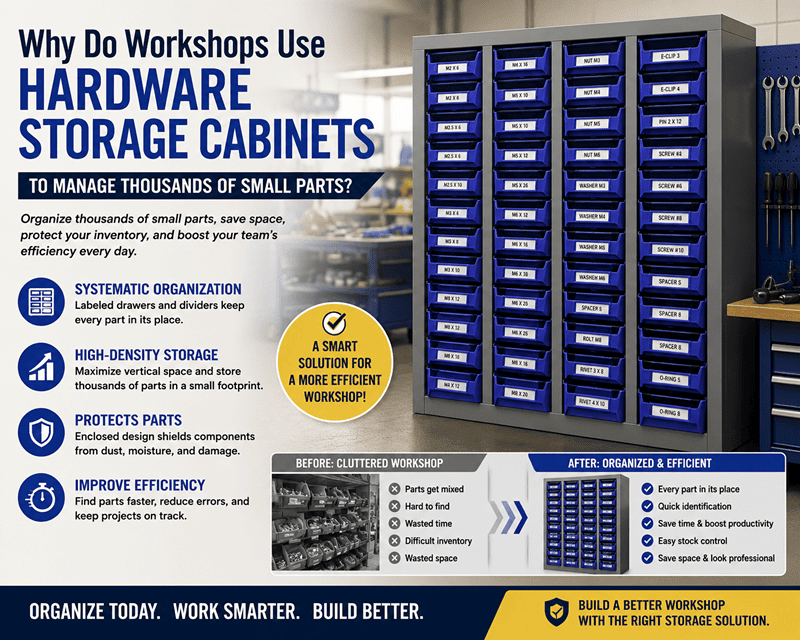
Why Do Workshops Use Hardware Storage Cabinets to Manage Thousands of Small Parts? Are you tired of seeing your workshop floor in chaos? Wasting time looking for tiny screws and parts hurts your team's productivity and delays important projects every single day.1
Hardware storage cabinets are essential for workshops because they provide a systematic way to organize thousands of small parts. They use labeled drawers with dividers for strong classification, offer high-density vertical storage to save space, and protect components from dust and damage, boosting picking efficiency and reducing errors2.
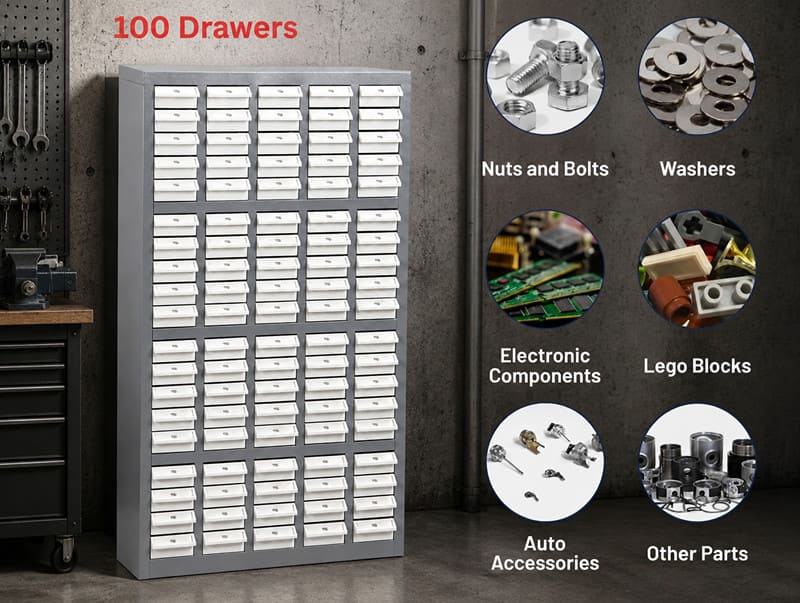
I've visited countless workshops over the years, and I've seen the same problem again and again: a messy pile of bins and boxes filled with mixed-up nuts, bolts, and fasteners. This disorganization isn't just ugly; it's a huge drain on efficiency and a direct cause of production mistakes3. A well-organized system is not a luxury, it's a necessity.4 Let's explore exactly how these cabinets transform a workshop from a cluttered space into a model of efficiency.
How Do Hardware Storage Cabinets Improve Small Parts Organization and Picking Efficiency in Workshops?
Are your workers constantly digging through messy bins for the right part? This daily hunt wastes valuable time and often leads to using the wrong component, causing assembly errors.
These cabinets improve efficiency by creating a fixed, labeled location for every single part. With multiple drawers and adjustable dividers, everything has its place. Workers can instantly find what they need, grab it, and get back to work, dramatically speeding up workflow and reducing mistakes.
Based on my experience, the biggest time-waster in any workshop is the search for parts. It's a silent productivity killer. By implementing a proper storage system, you give your team the tools they need to work smarter, not harder. A cabinet isn't just a piece of furniture; it's a process improvement tool. It brings order to the chaos and makes standardized work possible. Let's break down how this happens.
Strong Classification and Visual Management
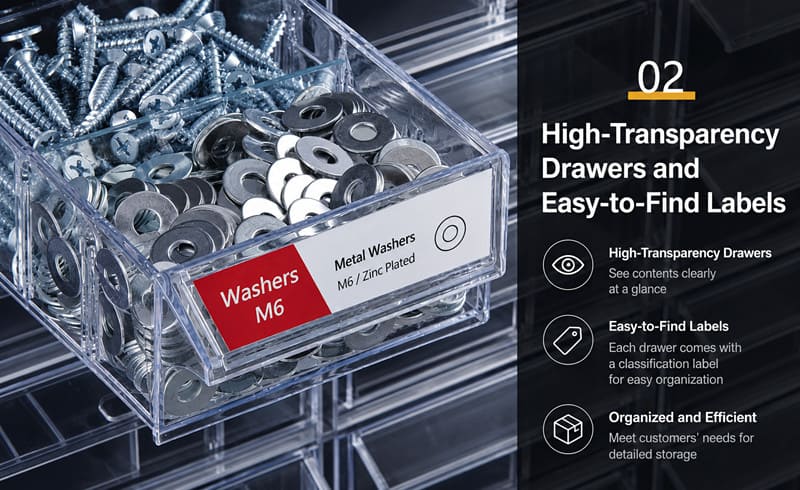
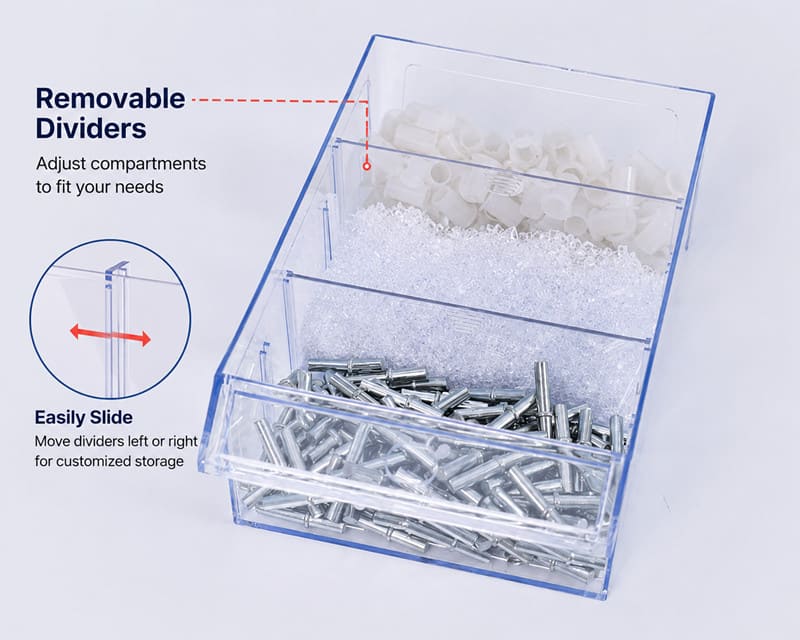
The core strength of these cabinets is their ability to classify. Unlike open bins on a shelf where parts inevitably get mixed, multi-drawer cabinets keep everything separate. You can use adjustable dividers inside each drawer to create custom-sized compartments for different screws, washers, or electronic components. Each drawer gets a label. This simple visual system means a worker doesn't have to guess or remember where things are. They just read the label, open the drawer, and pick the part. This method supports 5S management5 by creating a clean, organized workspace where inventory is easy to manage and count.
| Before (Bins on Shelves) | After (Hardware Storage Cabinet) |
|---|---|
| Parts get mixed together | Each part has its own compartment |
| Time wasted searching | Quick identification with labels |
| Hard to track inventory | Easy and accurate stock checks |
| Cluttered and unprofessional look | Clean, organized, and professional |
What Features Should You Look for in a Heavy-Duty Hardware Storage Cabinet for Industrial Use?
Have you bought cheap plastic organizers only to see them crack and fail? This not only wastes money but also leads to spilled parts and potential safety hazards on the workshop floor.
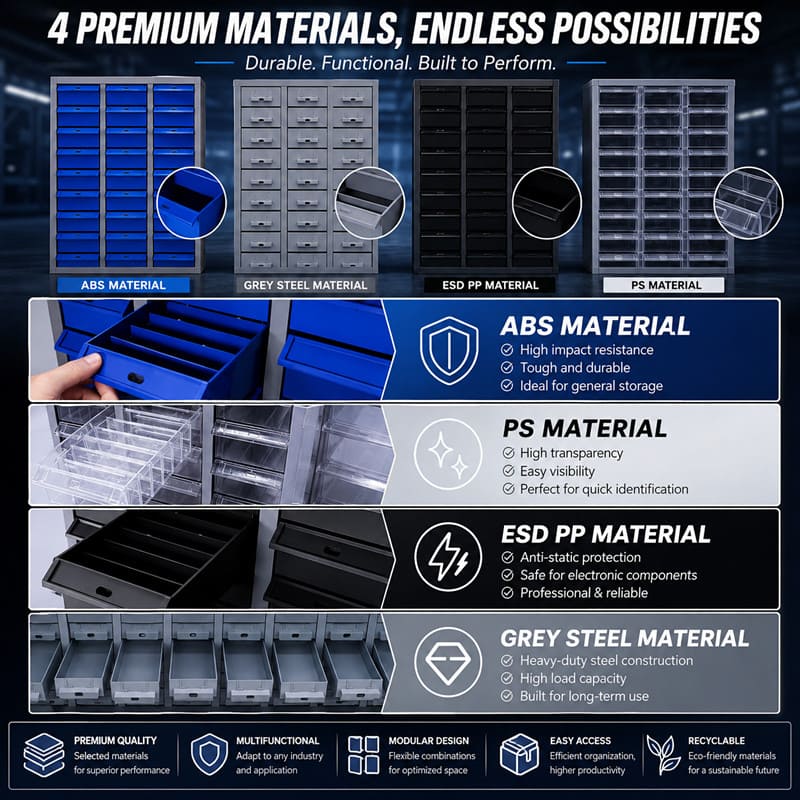
For industrial use, you need a cabinet with a heavy-duty steel frame for high load capacity and durability6. Look for impact-resistant and oil-resistant drawers. A fully enclosed design is also crucial to protect valuable hardware parts from the dust, moisture, and debris7 common in workshops.
In a busy industrial environment, equipment has to be tough. I've seen flimsy cabinets collapse under the weight of heavy bolts and fasteners, creating a huge mess and safety risk8. Investing in a robust, purpose-built unit is the only way to guarantee long-term reliability and protect your inventory. Not all cabinets are created equal, so you need to know what to look for to ensure you get a product that can handle the demands of your workshop.
Built for the Workshop Environment
The first thing to check is the construction. A cabinet made from cold-rolled steel with a powder-coated finish is the industry standard for a reason9. This combination provides the strength to hold heavy parts without buckling and offers excellent resistance to corrosion, oil, and scratches10. The drawers themselves should also be durable, often made from high-impact materials like PS or ABS plastic that won't crack11 if something is dropped in them. The goal is to invest once in a solution that will last for years, not something you have to replace every six months.
| Key Feature | Why It Matters in a Workshop |
|---|---|
| Cold-Rolled Steel Frame | Provides high load capacity for heavy parts and ensures long service life. |
| Impact-Resistant Drawers | Prevents cracking and damage from daily use and accidental drops. |
| Enclosed Cabinet Design | Protects parts from dust, moisture, and debris, preventing rust and contamination. |
| Powder-Coated Finish | Resists oil, grease, and corrosion, keeping the cabinet in good condition. |
Why Are Multi-Drawer Hardware Storage Cabinets Better Than Traditional Shelves for Managing Thousands of Small Parts?
Are your workshop shelves overflowing with disorganized bins? This common setup eats up valuable floor space while making it nearly impossible to find small components when you need them.
Multi-drawer cabinets are far superior because they offer high-density storage that maximizes vertical space12. A single cabinet can store the same amount as several shelving units, freeing up your floor. This organized system also prevents part mix-ups and makes inventory control much simpler.
Many companies I work with start out using standard shelves with plastic bins. It seems like a cheap and easy solution at first, but as their inventory of small parts grows, the system quickly becomes unmanageable. The shelves take up a huge amount of room, the bins become a jumbled mess, and no one can find anything. Switching to a vertical, multi-drawer cabinet system is one of the most effective changes a workshop can make to improve its layout and workflow.
Superior Space and Inventory Control
The most obvious benefit is space utilization. A tall, slender cabinet has a very small footprint but can hold thousands of individual parts in its drawers. This frees up valuable floor area for more workstations or machinery. Beyond just saving space, cabinets provide better control. With traditional shelves, parts are exposed to dust and can easily get lost or spilled. It's also difficult to know how much stock you have. With a drawer cabinet, everything is enclosed and protected. To check inventory, you simply pull out a drawer and you can see exactly what you have. This prevents the hidden costs that come from losing parts and having to reorder them unnecessarily.
| Aspect | Traditional Shelves with Bins | Multi-Drawer Hardware Cabinet |
|---|---|---|
| Space Utilization | Low density; requires a large footprint. | High density; uses vertical space efficiently. |
| Organization | Parts easily get mixed; hard to find. | Separate drawers for perfect organization. |
| Part Protection | Exposed to dust, moisture, and damage. | Enclosed design protects from contaminants. |
| Inventory Management | Difficult and time-consuming to count. | Simple, fast, and accurate stock checks. |
Conclusion
Hardware storage cabinets are an essential tool for any modern workshop. They organize small parts, save valuable space, protect your inventory, and make your entire operation more efficient.
"National Institute for Occupational Safety and Health | NIOSH", https://www.cdc.gov/niosh/index.html. Research on workplace interruptions and time loss supports that search time and task disruption can reduce productive work time, providing a basis for linking disorganized parts storage with productivity losses. Evidence role: general_support; source type: paper. Supports: Time spent searching for small parts reduces productivity and can delay work.. Scope note: The evidence is likely to address workplace time loss or interruptions broadly rather than measuring screw-searching in workshops specifically. ↩
"[PDF] Guidance on the Application of Human Factors to Consumer Products", https://www.cpsc.gov/s3fs-public/Human-Factors-Standard-Practice-Document-Final-ENGLISH-Feb03-2020_0.pdf. Studies of order-picking and warehouse storage systems show that item location assignment, labeling, and structured storage can improve picking performance and reduce picking errors; this supports the operational logic of labeled small-parts cabinets by analogy. Evidence role: expert_consensus; source type: paper. Supports: Labeled, organized storage can improve picking efficiency and reduce errors.. Scope note: Most research is in warehousing or order-picking environments, so the support is contextual rather than direct proof for every workshop cabinet installation. ↩
"The Impact and Challenges of the Implementation of 5S ... - PMC - NIH", https://pmc.ncbi.nlm.nih.gov/articles/PMC11326763/. Lean manufacturing literature identifies disorganization, searching, and poor workplace arrangement as contributors to process waste and error opportunities, supporting the claim that mixed or unclear parts storage can contribute to production mistakes. Evidence role: mechanism; source type: paper. Supports: Disorganized parts storage can contribute to production mistakes.. Scope note: Such sources usually describe a general mechanism and may not quantify the share of mistakes caused by disorganized small-parts storage. ↩
"1910.176 - Handling materials - general. | Occupational Safety and ...", http://www.osha.gov/laws-regs/regulations/standardnumber/1910/1910.176. Occupational safety and lean-production guidance commonly treats orderly storage and housekeeping as core requirements for safe and efficient operations, supporting the characterization of organized storage as an operational necessity. Evidence role: expert_consensus; source type: government. Supports: Organized storage systems are important for safe and efficient workshop operations.. Scope note: This supports the general importance of organization rather than proving that every workshop requires hardware storage cabinets specifically. ↩
"5S (methodology) - Wikipedia", https://en.wikipedia.org/wiki/5S_(methodology). Descriptions of 5S methods define sorting, setting in order, cleaning, standardizing, and sustaining as practices for workplace organization and visual control, supporting the claim that labeled, separated storage aligns with 5S principles. Evidence role: definition; source type: institution. Supports: Labeled drawers and separated compartments are consistent with 5S workplace organization practices.. Scope note: The source would establish conceptual alignment with 5S, not demonstrate the performance of a specific cabinet product. ↩
"[PDF] Mechanical properties of structural steel - GovInfo", https://www.govinfo.gov/content/pkg/GOVPUB-C13-8620f9e60cbfd1c3ac9e0bf55ba3770c/pdf/GOVPUB-C13-8620f9e60cbfd1c3ac9e0bf55ba3770c.pdf. Materials engineering references describe steel as having high strength and stiffness relative to many common plastics and wood products, supporting its use where load capacity and structural durability are required. Evidence role: mechanism; source type: education. Supports: Steel frames are suitable for storage cabinets requiring high load capacity and durability.. Scope note: Material properties support the design rationale but do not verify the load rating of any individual cabinet model. ↩
"PDR: CORR-DATA - NIST Data Repository", https://data.nist.gov/pdr/lps/54AE54FB37AC022DE0531A570681D4291851. Conservation and corrosion-prevention guidance identifies moisture, dust, and contaminants as factors that can accelerate deterioration or corrosion of stored metal items, supporting the protective rationale for enclosed storage. Evidence role: mechanism; source type: government. Supports: Enclosed storage can help protect hardware parts from dust, moisture, and debris.. Scope note: The evidence supports protection from environmental exposure generally, not the exact degree of protection offered by a particular cabinet design. ↩
"[PDF] Slips Trips Falls Hand out for Safety Committee Meetings - OSHA", https://www.osha.gov/sites/default/files/2018-12/fy16_sh-29672-sh6_SlipsTripsFallsHandoutforSafetyCommitteeMeetings.pdf. Occupational safety guidance on housekeeping and material storage notes that clutter, spilled materials, and poorly stored items can create slip, trip, fall, and struck-by hazards, supporting the link between failed storage and workshop safety risk. Evidence role: expert_consensus; source type: government. Supports: Spilled parts and failed storage can create safety risks in workshops.. Scope note: The source would support the general safety mechanism and may not discuss hardware cabinets specifically. ↩
"Accelerated Corrosion Tests in Quality Labels for Powder Coatings ...", https://pmc.ncbi.nlm.nih.gov/articles/PMC8585214/. Technical references on powder coating describe it as a durable coating process that can improve resistance to corrosion, chipping, and wear on metal substrates, supporting the rationale for its use on steel storage equipment. Evidence role: mechanism; source type: research. Supports: Powder-coated steel is used because it provides durability and corrosion resistance for metal equipment.. Scope note: This supports the functional advantage of powder-coated steel but may not establish that it is the universal industry standard for all hardware cabinets. ↩
"Accelerated Corrosion Tests in Quality Labels for Powder Coatings ...", https://pmc.ncbi.nlm.nih.gov/articles/PMC8585214/. Coatings literature and technical standards describe powder coatings as protective organic coatings that can improve corrosion resistance and mechanical durability of metal surfaces, supporting the claim about resistance to corrosion and scratching. Evidence role: mechanism; source type: paper. Supports: Powder-coated finishes can improve corrosion and scratch resistance on steel cabinets.. Scope note: Resistance to oil and scratches varies by coating chemistry, thickness, surface preparation, and test conditions. ↩
"Acrylonitrile butadiene styrene - Wikipedia", https://en.wikipedia.org/wiki/Acrylonitrile_butadiene_styrene. Polymer engineering references describe ABS as an engineering thermoplastic valued for impact resistance and toughness, supporting its use for drawers exposed to routine handling and dropped items. Evidence role: mechanism; source type: education. Supports: ABS and similar plastics are used where impact resistance is desired for storage drawers.. Scope note: The statement that drawers 'won't crack' is stronger than the material evidence; actual cracking depends on formulation, temperature, load, aging, and impact severity. ↩
"Warehouse Storage Solutions | Maximize Space & Efficiency", https://verticalstorageusa.com/. Facilities planning and storage-system references explain that vertical storage and high-density compartmentalized systems can increase storage capacity per unit floor area, supporting the claim that multi-drawer cabinets can improve space utilization. Evidence role: mechanism; source type: education. Supports: Multi-drawer vertical storage can increase storage density and improve floor-space utilization.. Scope note: The magnitude of space savings depends on cabinet dimensions, shelving layout, part sizes, and access requirements. ↩