Struggling with wobbly tables that risk safety and precision? Your standard workbench might not be up to the task, causing costly mistakes and potential accidents in your workshop.
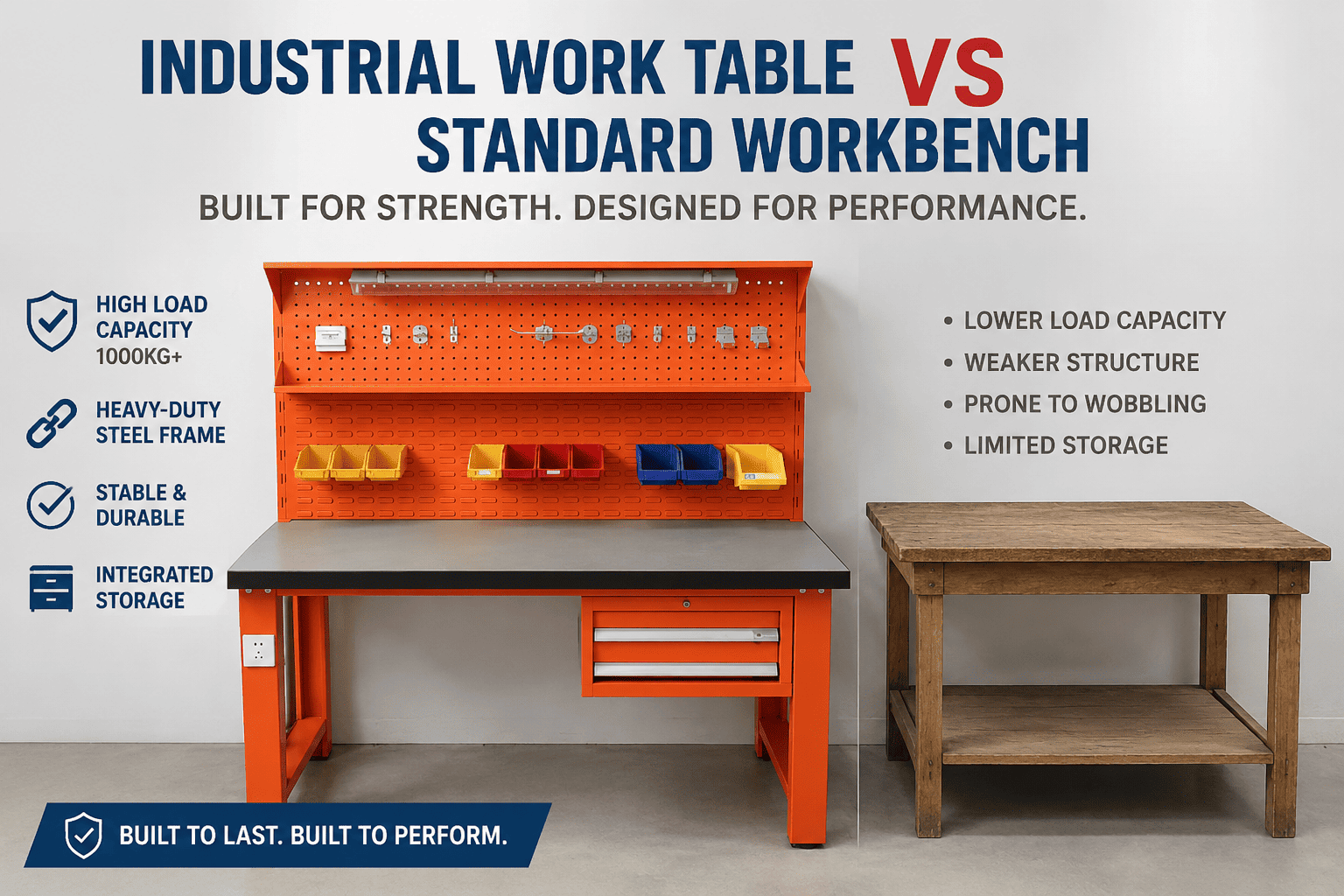
An industrial work table is built with heavy-gauge steel for high load capacity and stability1. A standard workbench often uses lighter materials, making it unsuitable for heavy machinery or intense assembly tasks2. The key difference is durability and strength designed for professional environments.
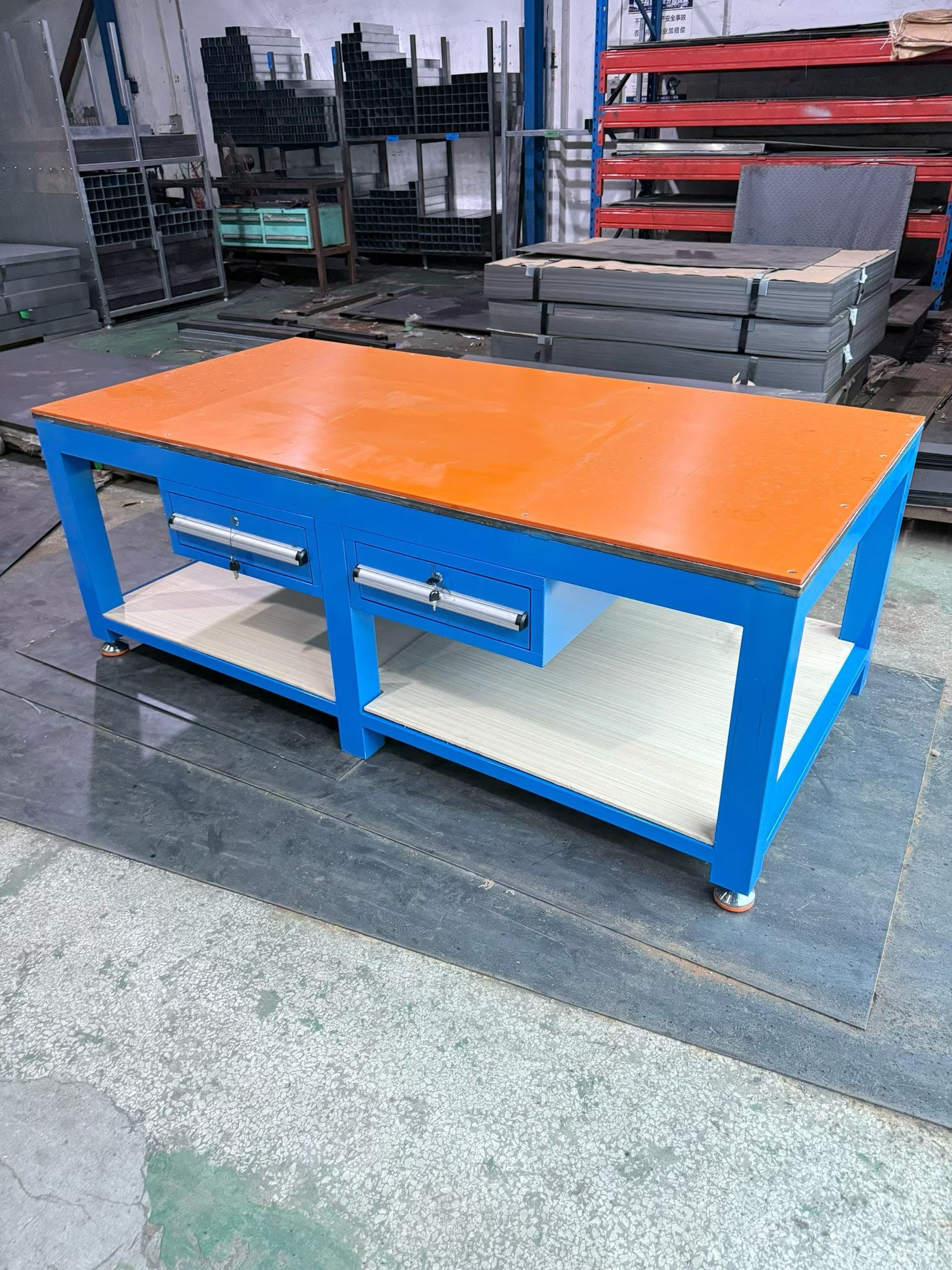
I've seen this firsthand in many workshops I've visited. A client was using a standard workbench for mold repair, and the constant vibration was ruining their precision work. They were frustrated with the amount of rework needed. It wasn't until we replaced it with a proper industrial table that they finally eliminated those costly errors. But the differences go much deeper than just a wobbly surface. Let's break down what really sets these two types of tables apart, so you can make the right choice for your facility.
What Is the Difference Between an Industrial Work Table and a Standard Workbench in Terms of Load Capacity and Structural Strength?
Worried your workbench might collapse under a heavy engine block or die set? Using a standard bench for industrial loads is a risky gamble that can lead to disaster.
Industrial work tables are engineered with reinforced steel frames and thick tops to handle loads from 1,000 kg to over 3,000 kg3. Standard workbenches typically support only a few hundred kilograms4, making them prone to bending, warping, and failure under heavy industrial stress.
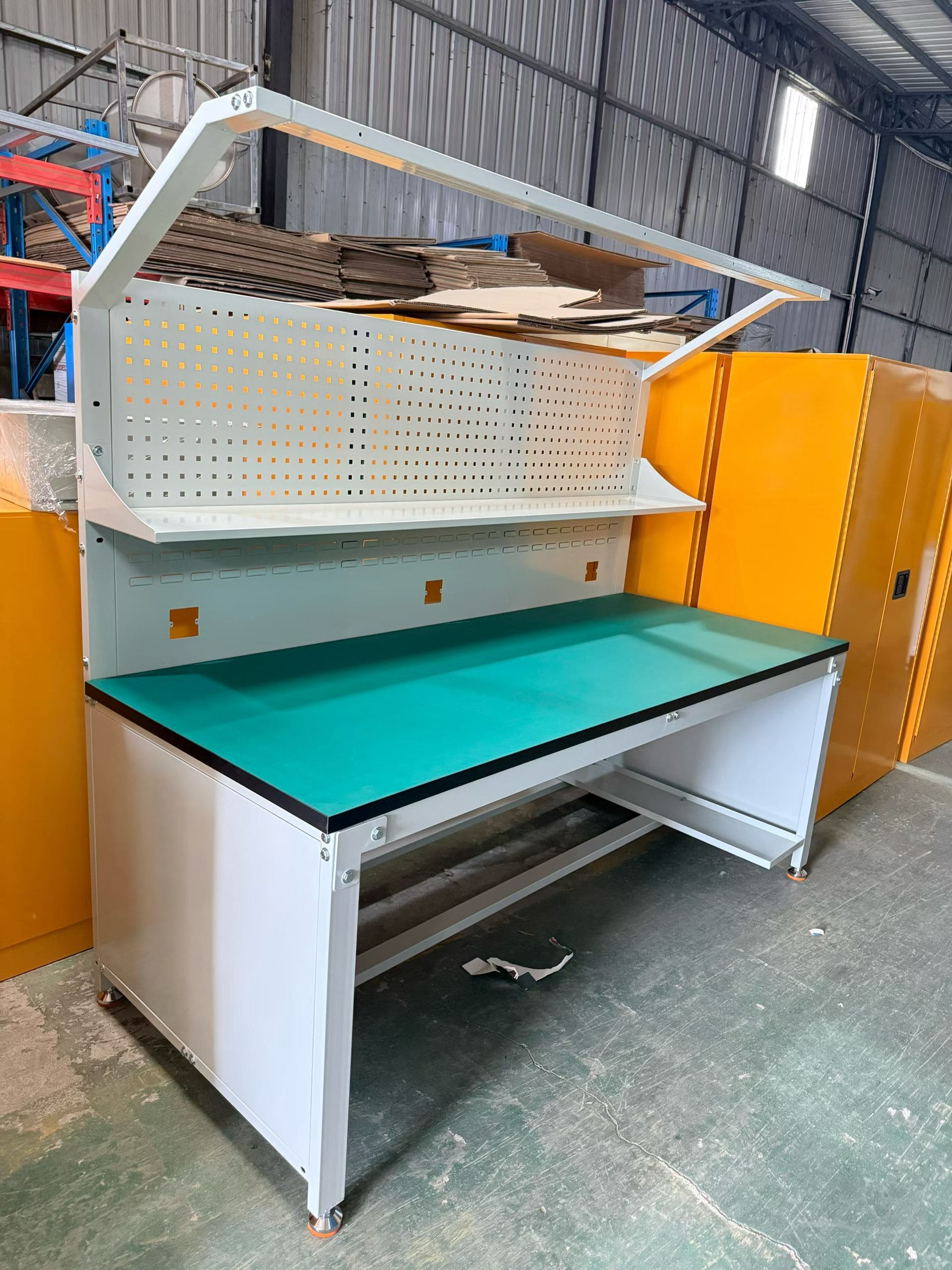
This is where the engineering really matters. I remember visiting a metal fabrication shop where a standard bench had visibly bowed in the middle under the weight of some steel plates. They were lucky it hadn't collapsed completely. The difference comes down to the materials and the way the table is constructed. An industrial work table isn't just a table; it's a piece of engineered equipment designed for one purpose: to withstand the extreme demands of a factory floor.
Material and Gauge Comparison
The foundation of this strength is the material. Industrial tables use heavy-gauge steel, often 2.0mm or thicker5, for the legs and frame. This provides a rigid and unyielding base. In contrast, standard benches might use thinner steel, aluminum, or even wood, which simply can't withstand constant, heavy pressure without deforming.
Structural Reinforcements
If you look underneath an industrial work table, you'll see the difference immediately. They feature welded joints and heavy-duty cross-bracing%%%FOOTNOTE_REF6%%%. These support beams are strategically placed to [distribute weight evenly across the entire structure](https://en.wikipedia.org/wiki/Beam(structure))7. This prevents the top from sagging and stops the legs from buckling. Standard benches often lack these essential reinforcements, relying on simple screw-together construction that loosens over time.
Here’s a quick comparison to make it clear:
| Feature | Industrial Work Table | Standard Workbench |
|---|---|---|
| Material | Heavy-gauge steel (e.g., 2.0mm+) | Lighter steel, wood, particleboard |
| Load Capacity | 1,000 kg - 3,000+ kg | 100 kg - 500 kg |
| Joints | Fully welded or heavy-duty bolts | Screws, light bolts |
| Reinforcement | Cross-bracing, support beams | Minimal or none |
Why Do Standard Workbenches Fail in Heavy-Duty Industrial Environments and Lead to Efficiency and Safety Issues?
Is operator fatigue and frequent rework hurting your bottom line? A flimsy workbench could be the hidden cause, creating an unsafe and inefficient workspace for your team.
Standard workbenches fail because they are not designed for the constant vibration, impacts, and heavy loads of industrial work. This instability leads to imprecise tasks, operator fatigue, and serious safety hazards like tool slippage or structural collapse, slowing down production.
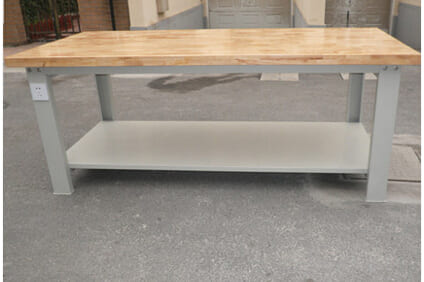
I once helped a client who couldn't figure out why their electronics assembly line had such a high defect rate. It turned out their standard workbenches were vibrating every time a worker used a pneumatic screwdriver. This tiny movement forced workers to slow down and struggle to maintain accuracy. The problem isn't just about a dramatic collapse; it's about the subtle ways a poor workbench undermines your entire operation day after day.
The Ripple Effect of Instability
A wobbly surface doesn't just feel unprofessional; it has real, measurable consequences for your business.
- Precision Loss: For tasks like SMT work, mold polishing, or calibrating instruments, even micro-vibrations can lead to defects, rework, and wasted materials8. The table should be a stable foundation, not a source of error.
- Operator Strain: Workers unconsciously tense their muscles to stabilize their hands and tools on a shaky table. Over an eight-hour shift, this causes significant physical fatigue, reduces focus, and can even lead to repetitive strain injuries9.
The Inevitable Breakdown
Materials not meant for industrial stress will eventually fail. Here's how standard benches break down under pressure:
- Material Fatigue: Simple screw-together joints loosen with vibration10. The frame loses its rigidity, and the whole table starts to wobble more and more.
- Surface Degradation: The work surface, often made of particleboard or thin metal, gets dented, scratched, and gouged. This creates an uneven surface that is both difficult and unsafe to work on.
- Safety Risks: An overloaded or weakened bench is an accident waiting to happen. A sudden collapse could cause serious injury11 to an employee and damage expensive equipment or products.
How Do Industrial Work Tables Improve Production Efficiency, Ergonomics, and Workflow in Factory Workstations?
Is your workstation a chaotic mess of tools and parts? A disorganized space slows down production, creates frustration, and is often a sign of an inadequate setup.
Industrial work tables are designed as modular systems. They integrate storage like drawer cabinets and pegboards, along with task lighting and power outlets. This organized setup minimizes movement, reduces search time for tools12, and creates a more ergonomic and efficient workflow.
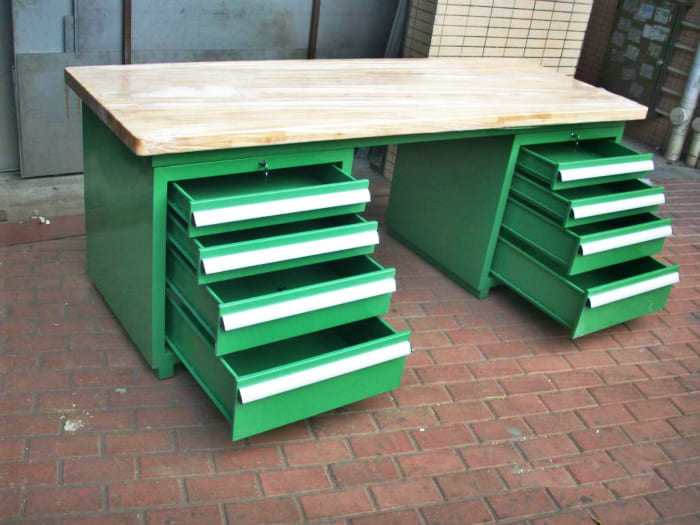
We don't just sell tables; we provide complete workstation solutions. I worked with a customer in the automotive repair industry who needed to streamline their engine teardown process. Their mechanics were wasting valuable time walking back and forth to a central tool chest. We designed a workstation with a heavy-duty table, integrated parts cabinets for small components, a louvered panel for parts bins, and an overhead light. The change was immediate. Their efficiency improved because everything they needed was right there.
Creating an Efficient Ecosystem
An industrial work table is the foundation of an optimized workstation. It brings everything together.
- Ergonomics: Many of our tables are height-adjustable, allowing operators to work comfortably whether they are sitting or standing. This simple feature reduces back strain, improves focus, and shows your team you care about their well-being.
- Workflow Integration: When everything has a dedicated place, the workflow becomes smooth and predictable. Tools are within arm's reach. Power is built-in. This approach aligns perfectly with 5S methodology, creating a clean, organized, and highly productive environment.
Customization for Specific Tasks
Different jobs have different needs. A great industrial table adapts to the task.
| Customization Option | Benefit for Workflow |
|---|---|
| Drawer Cabinets | Securely store valuable tools and sensitive parts right at the point of use. |
| Pegboard/Louver Panels | Organize hand tools and parts bins for quick visual access and retrieval. |
| Overhead Lighting | Eliminates shadows on the work surface, improving visibility for detailed tasks. |
| Integrated Power Strips | Provides convenient, safe access to electricity for power tools and equipment. |
| ESD-Safe Surfaces | Protects sensitive electronic components from static discharge during assembly. |
This modular approach means you can build the exact workstation your team needs, which directly translates into higher productivity and better quality work.
Conclusion
Choosing an industrial work table over a standard bench is an investment in your factory's safety, efficiency, and long-term productivity. It’s the professional choice for any serious operation.
"A machine learning approach for predicting a full load-deflection ...", https://ui.adsabs.harvard.edu/link_gateway/2025EngSt.33720580D/doi:10.1016/j.engstruct.2025.120580. A structural engineering or materials reference can support that increasing steel section thickness and stiffness improves load-bearing capacity and resistance to deflection in work-support structures. Evidence role: mechanism; source type: education. Supports: Industrial work tables use heavy-gauge steel to provide higher load capacity and stability.. Scope note: This would support the engineering principle generally, not certify the load rating of any specific table model. ↩
"1926.600 - Equipment. | Occupational Safety and Health ... - OSHA", http://www.osha.gov/laws-regs/regulations/standardnumber/1926/1926.600. A safety or engineering source can document that work surfaces and supports must be rated for expected loads and dynamic forces, giving context for why lighter benches may be unsuitable for heavy machinery or intensive assembly. Evidence role: general_support; source type: government. Supports: Standard workbenches made from lighter materials may be unsuitable for heavy machinery or intense assembly tasks.. Scope note: The source may establish load-rating principles rather than compare every standard workbench design directly. ↩
"[PDF] A Guide to Scaffold Use in the Construction Industry - OSHA", https://www.osha.gov/sites/default/files/publications/OSHA3150.pdf. A neutral product-standard, institutional procurement specification, or engineering reference can show that heavy-duty industrial work tables are commonly specified with load ratings in the 1,000–3,000 kg range. Evidence role: statistic; source type: institution. Supports: Industrial work tables are engineered to handle loads from 1,000 kg to over 3,000 kg.. Scope note: Available evidence may come from procurement specifications or cataloged examples rather than an industry-wide statistical survey. ↩
"The Ultimate Guide to Industrial Workbenches | Knowledge Center", https://www.globalindustrial.com/knowledge-center/article/the-ultimate-guide-to-industrial-workbenches?srsltid=AfmBOoq5i7zHL4NQXtoB_pJL4-ncYvOhlcQv7rd02xhCJICk0DHL6JGM. A neutral specification or safety source can provide context that light-duty or general-purpose benches are commonly rated for substantially lower loads than heavy industrial benches. Evidence role: statistic; source type: institution. Supports: Standard workbenches typically support only a few hundred kilograms.. Scope note: Ratings vary widely by design, so the evidence should be presented as contextual rather than universal for all standard workbenches. ↩
"[PDF] 3. STRENGTH AGAINST BENDING - UPCommons", https://upcommons.upc.edu/bitstreams/152f6602-e337-44dc-af73-0edc1663b0a7/download. A structural steel or sheet-metal reference can confirm that steel thickness is measured in millimeters or gauge and that thicker sections provide greater resistance to bending under load. Evidence role: mechanism; source type: education. Supports: Industrial tables often use steel of 2.0 mm thickness or greater for legs and frames.. Scope note: This supports the relevance of 2.0 mm thickness to strength but may not prove that all industrial work tables use this exact minimum thickness. ↩
"[PDF] Inelastic Lateral Instability Of Beams And Their Bracing Requirements.", https://preserve.lehigh.edu/system/files/derivatives/coverpage/427283.pdf. A structural mechanics source can support that welded or rigid joints and cross-bracing increase frame stiffness and improve resistance to lateral movement or buckling. Evidence role: mechanism; source type: education. Supports: Industrial work tables use welded joints and heavy-duty cross-bracing to improve structural strength and stability.. Scope note: This supports the design principle, not the performance of a particular table unless paired with a rated test or specification. ↩
"Beam (structure) - Wikipedia", https://en.wikipedia.org/wiki/Beam_(structure). A structural engineering reference can explain that support beams and bracing help transfer loads through a frame, reducing localized deflection and stress concentrations. Evidence role: mechanism; source type: education. Supports: Support beams and cross-bracing distribute weight across the work table structure.. Scope note: The source would describe general load-transfer behavior rather than verify a specific industrial table design. ↩
"Performance Analysis of Advanced Feature Extraction ... - PMC", https://pmc.ncbi.nlm.nih.gov/articles/PMC13075307/. Research on precision manufacturing and metrology can support that vibration at the work surface can degrade accuracy and contribute to defects in precision tasks. Evidence role: mechanism; source type: paper. Supports: Micro-vibrations can reduce precision and increase defects or rework in sensitive manufacturing tasks.. Scope note: The strength of support will depend on task type; evidence from metrology or electronics assembly may be contextual rather than directly about all workshop activities. ↩
"Ergonomics | Occupational Safety and Health Administration - OSHA", http://www.osha.gov/ergonomics. An occupational ergonomics source can support that sustained awkward postures, forceful exertion, and repetitive work are risk factors for work-related musculoskeletal disorders, including repetitive strain injuries. Evidence role: expert_consensus; source type: government. Supports: Unstable work surfaces may contribute to operator fatigue and repetitive strain injury risk by increasing muscular effort and awkward working patterns.. Scope note: The source may not identify shaky tables specifically as a direct cause, but it can support the ergonomic risk pathway described. ↩
"[PDF] NASA-STD-5020", https://s3vi.ndc.nasa.gov/ssri-kb/static/resources/nasa-std-5020.pdf. A mechanical engineering or fastening reference can document that cyclic vibration can reduce preload and cause threaded fasteners to self-loosen. Evidence role: mechanism; source type: paper. Supports: Screw-together joints can loosen under vibration in industrial use.. Scope note: The evidence would support the fastener-loosening mechanism generally, not show failure rates for every screw-together workbench. ↩
"1926.759 - Falling object protection. | Occupational Safety ... - OSHA", http://www.osha.gov/laws-regs/regulations/standardnumber/1926/1926.759. An occupational safety source can support that collapsing structures, falling objects, and overloaded supports are recognized workplace hazards capable of causing serious injury. Evidence role: general_support; source type: government. Supports: An overloaded or weakened bench that collapses can cause serious injury and equipment damage.. Scope note: The evidence would substantiate the hazard category rather than provide incident statistics for workbench collapses specifically. ↩
"Lean manufacturing - Wikipedia", https://en.wikipedia.org/wiki/Lean_manufacturing. Lean manufacturing and workplace-organization literature can support that point-of-use storage and 5S practices reduce unnecessary motion and time spent searching for tools. Evidence role: expert_consensus; source type: institution. Supports: Integrated storage and organized workstations can minimize worker movement and reduce tool-search time.. Scope note: This supports the workflow principle, but actual time savings depend on the workstation design and task mix. ↩